Church Soundproofing & Acoustic Treatment
Church soundproofing covers two distinct and independent tasks. Acoustic treatment reduces reverberation time inside the sanctuary to improve speech intelligibility while preserving the musical character of the space. Sound isolation prevents sound transmission between separate zones: the nursery, classrooms, fellowship halls, and the main worship space. Each task requires different methods, materials, and performance targets.
Church acoustics also carry a conflict that other commercial spaces don't have. The reverberation that makes choral singing and organ music sound full and majestic is the same reverberation that makes a spoken sermon hard to understand. That balance has to be settled as a design decision before any treatment begins.
Why Church Spaces Are Acoustically Difficult
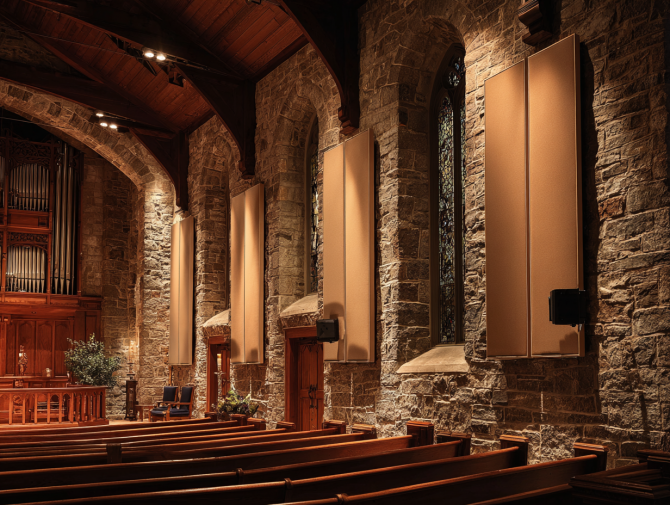
Church sanctuaries are acoustically difficult because of four factors that act at the same time and reinforce each other. First, a typical sanctuary holds 1,500 to 5,000 cubic meters of air, far more than most commercial spaces with similar occupancy. Second, the main surfaces, such as stone, concrete, plaster, masonry, and hardwood, are hard and reflective and absorb almost no sound. Third, high ceilings, domes, arches, and vaults create overlapping reflections that stretch reverberation across the space. Fourth, irregular geometry, including apses, alcoves, balconies, and recesses, creates acoustic shadow zones where sound reaches different seats unevenly.
RT60 is the standard measure of reverberation time: the number of seconds it takes sound to decay by 60 dB after the source stops. In untreated stone and masonry sanctuaries, RT60 typically measures 3 to 6 seconds. In modern evangelical churches built with drywall and steel framing, it usually falls between 1.5 and 2.5 seconds. Both exceed the threshold for acceptable speech intelligibility.
Above 1.5 seconds, syllables overlap in time. Each word is still ringing in the room while the next one is spoken, so the congregation hears a continuous wash of sound instead of distinct words. The longer the sentence, the greater the buildup and the lower the comprehension.
Amplified worship does not solve the reverberation problem; it amplifies it. Microphones pick up the speaker's voice and the room's reverberation together, and loudspeakers reproduce both. Equalization, compression, and volume can't remove reverberation that is already in the signal, so acoustic problems have to be solved at the room level, not at the mixing console.
Carpets, upholstered pews, and curtains help only a little. In a 3,000-cubic-meter sanctuary, soft furnishings cover a small area compared with the volume of air and the hard surfaces around them. They may reduce RT60 by 0.3 to 0.6 seconds in favorable conditions, which isn't enough to reach target values in a severely reverberant space.
Church Acoustic Panels and Sound Treatment
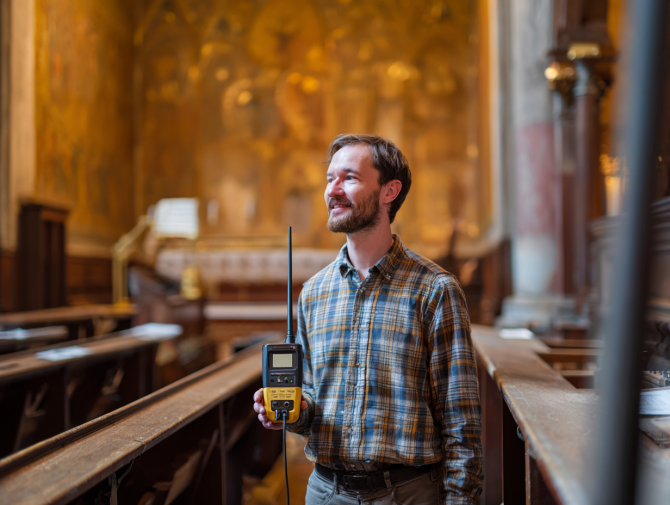
Church acoustic panels are the main tool for bringing reverberation down to a level where speech is clear but music still has room to breathe. Church sound panels come in several forms, and the right mix depends on the building, so most projects combine more than one type of treatment.
Wall Panels
Fabric-wrapped and perforated wood wall panels absorb reflections from side and rear walls, which cause most of the echo heard in the pews. We build them in custom sizes and finishes, so they sit between windows, columns, and architectural details without looking added on.
Ceiling Baffles and Clouds
High sanctuary ceilings hold a large share of the sound energy in the room. Suspended ceiling baffles and clouds add absorption overhead without touching the walls or blocking sightlines.
Acoustic Upholstery for Historic Interiors
Where panels would clash with the architecture, acoustic upholstery covers wall or ceiling areas in fabric over an absorptive layer. The surface reads as a finished wall, and the room sounds noticeably calmer.
Curtains and Variable Acoustics
Congregations that hold both choral services and amplified worship often need different acoustics on different days. Retractable panels and movable acoustic curtains add absorption for spoken services and open the room back up for organ and choir.
Our Church Soundproofing and Acoustic Treatment Services
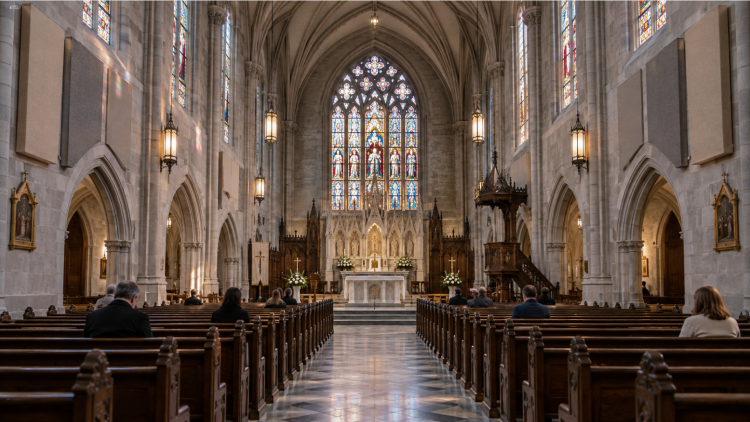
We provide acoustic treatment and sound isolation for church buildings of every architectural type, from historic stone sanctuaries to modern evangelical worship centers and multipurpose ministry facilities. Every project begins with calibrated RT60 and STI measurements taken at multiple positions in the sanctuary and adjacent spaces before anything is designed or installed.
We work with the following types of church facilities:
- Traditional stone and masonry sanctuaries
- Modern evangelical worship centers with amplified bands
- Multipurpose worship and education buildings
- School and university chapels
- Small parish churches and mission congregations
- Funeral home chapels and memorial spaces
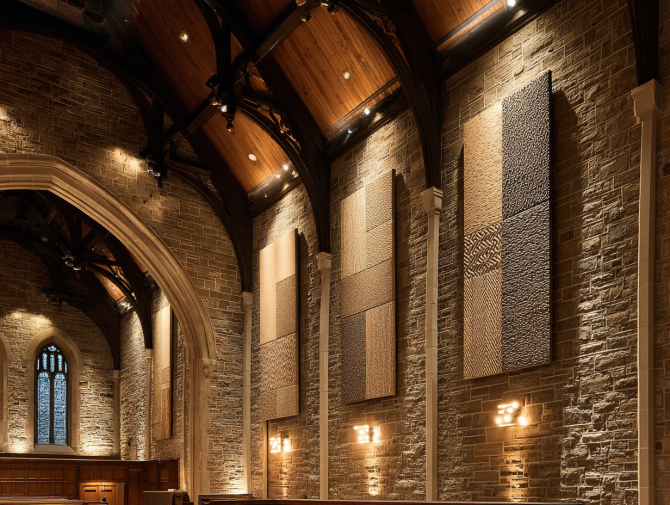
Acoustic panels are manufactured in-house to precise dimensions and in custom fabric colors and finishes. In traditional sanctuaries, this lets us match the existing interior palette, such as stone gray, warm beige, and dark wood tones, so treatment blends with the architecture instead of looking like an industrial addition.
Synagogues, Temples, and Fellowship Halls
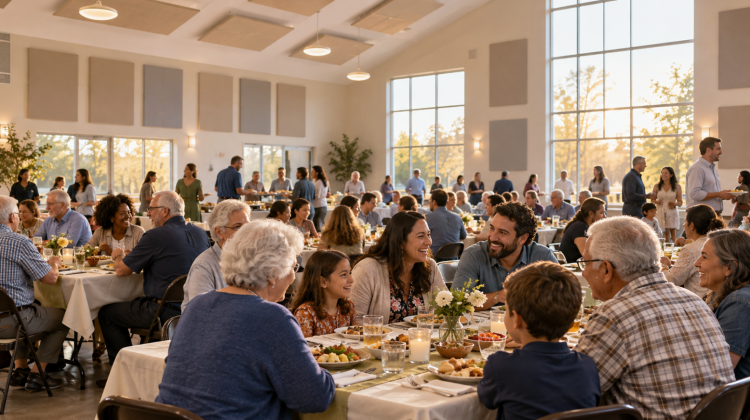
Houses of worship share the same acoustic challenges whatever the tradition. Synagogues, temples, and sanctuaries tend to have large volumes, hard surfaces, and irregular shapes that scatter sound unevenly. We bring the same measurement-based approach to each of them, and we've treated synagogue halls, historic buildings, and multi-use worship spaces where the goal was to change how the room sounds while keeping its look almost untouched.
Fellowship halls and event spaces attached to a congregation need a different target than the sanctuary. These rooms host meals, meetings, classes, and celebrations, so we aim for a shorter reverberation time, around 0.6 to 1.0 seconds, which keeps conversation comfortable when the hall is full.
Our Process
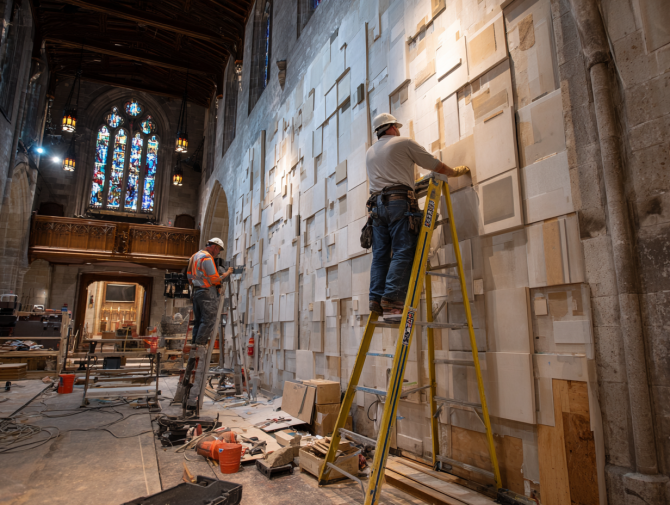
Every church acoustic project follows three stages: measurement, design, and verified installation. Each stage produces a defined deliverable: a measurement report, a treatment plan with specified targets, and a post-installation verification report. No treatment is designed without measurement, and no project is closed until the installed solution reaches the specified RT60 and STI targets.
Acoustic Assessment
We measure RT60 at a minimum of five positions across the sanctuary: front, rear, left, right, and center. Several positions are needed because RT60 varies across a large room, especially one with irregular geometry. STI is measured at typical seating positions to set the current speech intelligibility baseline. For zone isolation projects, we also measure ambient sound levels in adjacent spaces to determine the required STC for each partition element.
Solution Design
The design specifies the type, size, quantity, and placement of every acoustic element. For acoustic treatment, we calculate the total absorptive area needed to reach the target RT60 based on room volume, existing surface absorption, and ceiling height. Placement follows reflection analysis, identifying which surfaces contribute most to the measured RT60, rather than visual symmetry alone. For sound isolation, the design sets an STC target for each wall, door, window, and ceiling assembly and the construction approach for each.
Installation and Verification
Our own crew performs the installation. Afterward, we re-measure RT60 at the same positions used in the assessment and STI at the same seating positions. A written report documents the measurements before and after treatment, the materials installed, and the improvement at each position, giving you a permanent record of the space's acoustic performance.
Why Churches Choose Us for Acoustic Treatment
Acoustic treatment in worship spaces takes more than installing panels. It requires understanding the difference between a stone sanctuary and a drywall worship center, designing to measurable RT60 and STI targets, manufacturing elements that fit protected interiors, and confirming the result with measurements.
Experience with Traditional and Modern Worship Spaces
Traditional sanctuaries need different methods, finishes, and placement than modern evangelical buildings. We've worked in both and understand the constraints, such as protected windows, historic woodwork, and exposed stone, that limit where panels can go and which finishes are acceptable. We design treatment that works within those limits instead of altering the character of the space.
In-House Manufacturing with Custom Colors and Finishes
Panels for churches are made in our facility to exact project dimensions. Fabric options include neutral tones that coordinate with stone, plaster, and wood, and wood-finish elements, such as perforated panels and clouds in natural or stained wood, are available where fabric isn't appropriate. Custom sizing avoids the gaps and visible offcuts that come from forcing standard panels into non-standard spaces.
Pre- and Post-Installation RT60 and STI Measurements
Every project includes calibrated measurements before work starts and after installation. The first set forms the basis of the design, and the second confirms that the treatment reached its targets. You receive a written report with both, which is also useful for sound system design, facilities records, and future renovations.
Enhance Your Church's Acoustic Quality Today
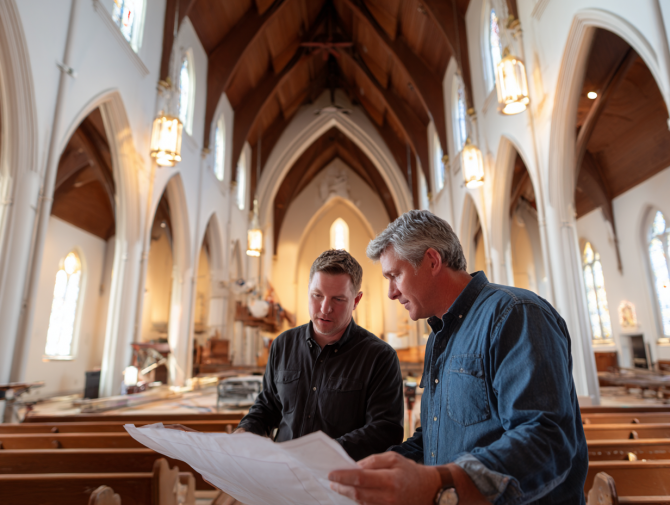
Ready to make every word and every note easier to hear? Call us at (877) 999-2201 for a free consultation, or browse our full range of soundproofing and acoustic treatment services. Wherever your congregation is located, in New York or beyond, we can help you create a better space for worship.
FREQUENTLY ASKED QUESTIONS
Can acoustic panels be installed in a historic church without affecting the architecture?
Acoustic panels can be installed in historic sanctuaries without permanent modification to existing surfaces. Ceiling-suspended baffles and clouds attach to existing structural elements using threaded rod and cable suspension hardware that does not require penetrating historic masonry or woodwork. Wall panels can be mounted on independent framing that stands away from historic walls rather than attaching directly to them. All elements can be removed without leaving visible marks on protected surfaces. Panel finishes — fabric color, wood species, paint color — can be specified to coordinate with the existing interior palette.
How much acoustic treatment does a typical sanctuary need?
The amount of treatment required depends on the room volume, the initial RT60, and the target RT60. As a general reference, reducing RT60 by 50% in a typical sanctuary — from 3.0 seconds to 1.5 seconds — requires adding absorptive area equivalent to approximately 15–25% of the ceiling area using 2-inch panels, or approximately 10–15% using 4-inch broadband panels. Precise quantities require a room volume calculation and a target RT60 calculation specific to the space. We calculate the required coverage as part of the acoustic assessment for every project.
How do I soundproof a church nursery?
Nursery soundproofing addresses four transmission paths in priority order. First, replace the hollow-core door with a solid-core door and install perimeter acoustic seals on all four sides of the frame. This addresses the most common and significant transmission path. Second, treat the shared wall with a decoupled assembly — resilient channels or staggered studs — with mass-loaded vinyl and two layers of drywall. Third, address the ceiling if sound transmits from above. Fourth, replace the observation window with an acoustic window assembly rated STC 40–45. The target for a nursery adjacent to a sanctuary is STC 50–55 across all elements.
How do I improve speech intelligibility in a church without removing the natural reverb?
Speech intelligibility and musical reverb are determined by the same physical parameter — RT60. Reducing RT60 improves STI but reduces the musical fullness of the space. The most effective approach for mixed-use sanctuaries is to reduce RT60 to the 1.2–1.6 second range, which provides acceptable STI (typically 0.50–0.60) while retaining enough reverberation for worship music to sound supported. Variable acoustics — motorized retractable panels or movable acoustic curtains — allow the room to be shifted between higher and lower RT60 for different service types.
What is STI and why does it matter for church acoustics?
STI (Speech Transmission Index) is the international standard measurement of speech intelligibility in a room, defined in IEC 60268-16. STI is measured on a scale from 0 to 1. A rating above 0.60 indicates Good intelligibility; below 0.45 indicates Poor intelligibility. In untreated sanctuaries with RT60 between 3 and 4 seconds, STI typically measures 0.30–0.40. At this level, a significant portion of the congregation cannot reliably follow spoken content, particularly in reverberant areas at the rear and sides of the room.
What is the difference between soundproofing and acoustic treatment for a church?
Acoustic treatment reduces reverberation inside a single room by adding absorptive surfaces — panels, baffles, clouds — that convert sound energy to heat. Soundproofing prevents sound from traveling between adjacent rooms through walls, doors, floors, and ceilings, using mass, decoupling, and airtight sealing. A room can be acoustically treated without being soundproofed, and soundproofed without being acoustically treated. Both tasks require different materials and are designed independently.
What RT60 is recommended for a church sanctuary?
The recommended RT60 depends on the primary use of the space. Traditional sanctuaries used primarily for choral and organ music perform best at RT60 of 1.8–2.5 seconds. Mixed-use sanctuaries with both spoken services and musical worship function best at 1.2–1.8 seconds. Modern evangelical churches with amplified bands target RT60 of 0.9–1.4 seconds. Fellowship halls and multipurpose spaces used primarily for conversation and instruction target 0.6–1.0 seconds.
In this video New York Soundproofing demonstrates the dramatic difference before - and after - installing our acoustic panels. This acoustic treatment project was at the Galaxy Visuals video studio - a state-of-the-art video studio in Brooklyn, NY.
The video room was turned from acoustically unusable to sounding exceptional!
When our clients moved into the space, there was so much echo they couldn't do any video shoots with decent sound, or even understand each other speak.
New York Soundproofing to the rescue! We installed acoustic panels that matched the space and could fit in an area that is outside of the camera frame for a fantastic result. This is only one example of many where we transform an unusable space into a great-sounding room fit for recording, listening and more.
Contact us today to see how we can help transform your space! (Also see Galaxy's client testimonial video below).

New York's Soundproofing Experts
We specialize in creating highly-customized sound environments such as home offices, recording studios, home studios and music rooms, conference & teleconference rooms, bars and clubs, offices, restaurants, temples, churches, school auditoriums and much more.