Soundproofing for Schools and Classrooms
New York Soundproofing designs, manufactures, and installs soundproofing for schools and classrooms, from Pre-K rooms to college lecture halls. We stop noise from traveling between rooms, cut the echo inside them, and help teachers be heard without raising their voices. Every school soundproofing project starts with measurements, not guesses. We find out where the noise comes from, build panels to fit each room in our own NYC shop, and install them on a schedule that keeps classes running across New York City, New Jersey, Greater Philadelphia, and Chicago.
What Is School and Classroom Soundproofing
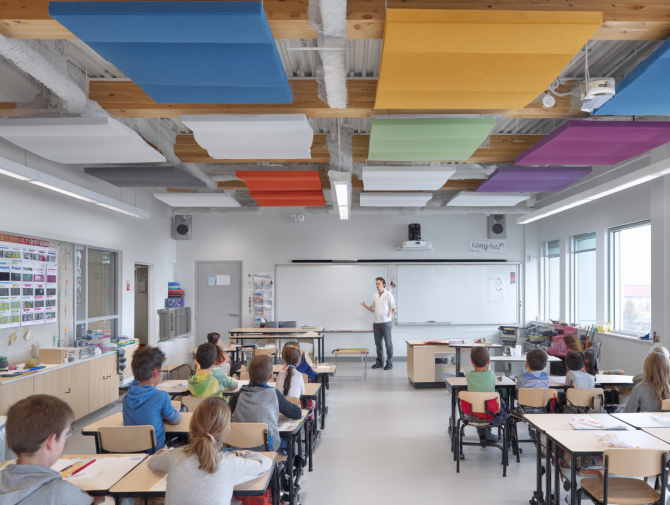
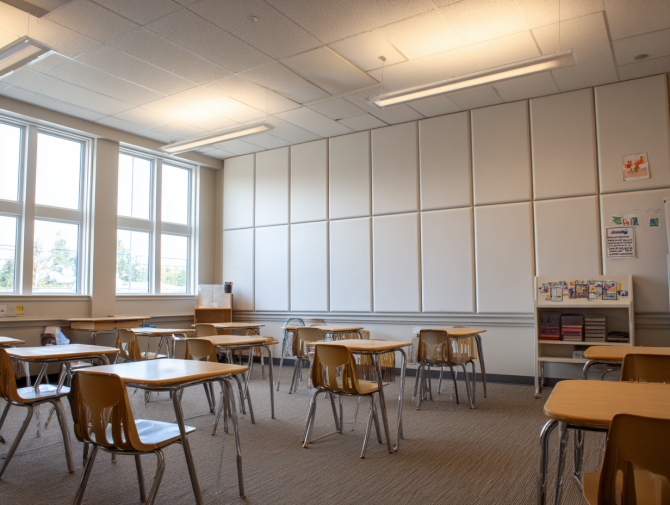
Soundproofing a classroom covers two jobs. One is blocking sound between spaces, such as a music lesson leaking into a math class or footsteps from the floor above. The other is controlling echo inside the room so speech stays clear. Blocking relies on mass and airtight seals and is rated with Sound Transmission Class (STC). Absorption relies on soft, porous surfaces like fabric-wrapped panels and is rated with the Noise Reduction Coefficient (NRC). Most schools need both.
Classroom acoustics also have a published benchmark. The ANSI/ASA S12.60-2010 standard sets a reverberation time of 0.6 seconds and a background noise limit of 35 dBA for core learning spaces under 10,000 cubic feet. We design to these targets and check the results against them after installation.
Common Noise Problems in Schools and Classrooms
Noise in schools rarely has a single source. These are the problems we see most often when soundproofing in schools, and a lasting fix usually addresses several of them at once.
Noise Between Classrooms
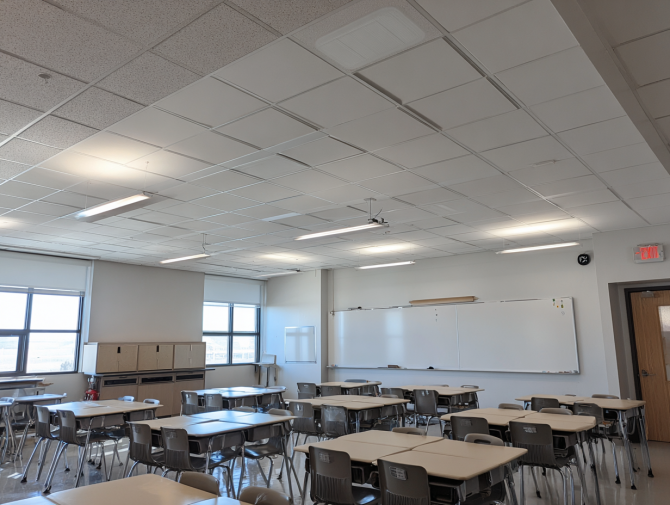
Voices and media audio pass through shared walls, especially partitions that stop at the drop ceiling. Sound also travels over walls through shared ceiling space, through corridors from door to door, and down from the floor above as footsteps and chair scrapes.
HVAC and Mechanical Noise
Ventilators, rooftop equipment, and ducts add a steady hum that raises background noise, and shared ducts can carry speech from one room to the next.
Excessive Reverberation
Tile, glass, block walls, and whiteboards reflect sound. Words blur together, and the room gets louder as students talk over the echo.
Street Noise and Open Learning Spaces
City schools deal with traffic, sirens, and construction coming through windows. Open-plan learning areas have the opposite problem: few walls, so every group's conversation becomes everyone's background noise.
Poor acoustics hit hardest for young children, English language learners, and students with hearing loss, and teachers who raise their voices all day end it with strained voices.
Our School Soundproofing Services
We handle school acoustics from the first walkthrough to the final measurement, with design and manufacturing done in-house.
Assessment and Sound Measurements
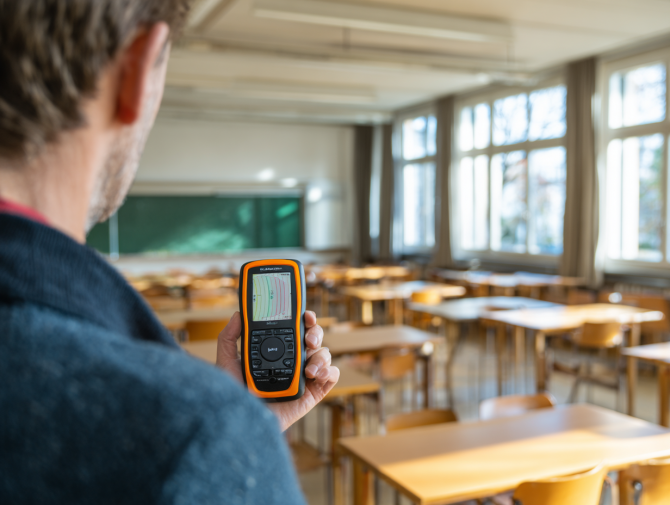
We walk the problem areas with your facilities staff, then measure background noise, reverberation time, and sound transfer between rooms. The results guide the design and give a baseline for checking the improvement later. Virtual consultations are available for early planning.
Acoustic Panels for Schools and Classrooms
Classroom acoustic panels are the main tool for acoustic treatment in classrooms. Fabric-wrapped wall panels absorb the reflections that cause echo, and we place them where they do the most good. We build them in our New York shop to fit around whiteboards, displays, and windows, which gives us control over sizes, fabrics, colors, and lead times. Panels can also be printed with school colors, logos, mascots, or student artwork, so they double as wall decoration.
Ceiling Treatment
In high-ceiling spaces, suspended baffles and clouds absorb sound without using wall space. In standard classrooms, high-absorption tiles or new drop ceiling systems treat the largest surface in the room. For full walls or ceilings, acoustic upholstery stretches fabric over an absorptive layer.
Doors and Windows
The door is usually the weakest point of a classroom wall. Door soundproofing adds perimeter seals and automatic door bottoms, while window soundproofing reduces street noise in rooms facing busy roads.
HVAC Noise Control and Sound Masking
We work with your mechanical contractor on duct lining, silencers, and equipment enclosures. In open learning areas and administrative suites, sound masking makes distant conversations less distracting.
Soundproofing Beyond the Classroom
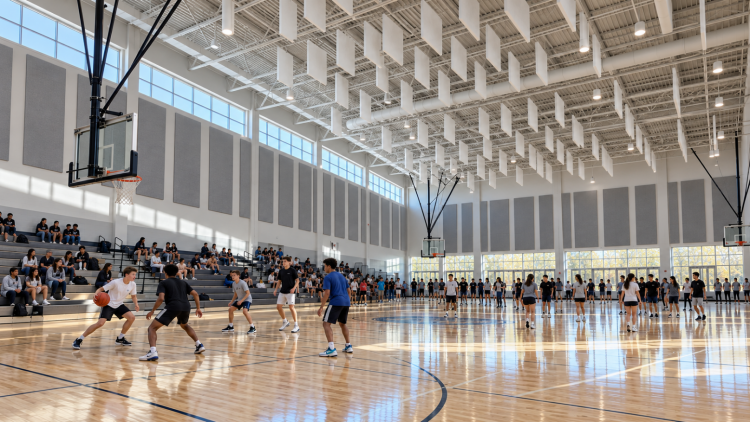
Gyms, cafeterias, and auditoriums are the loudest rooms in a school, and their noise often reaches nearby classrooms, so we treat the building as a whole.
Gymnasiums and Cafeterias
Hard floors, high ceilings, and hundreds of students mean kids end up shouting to be heard. Ceiling baffles and impact-resistant wall panels bring the level down. See gym soundproofing and cafeteria soundproofing.
Auditoriums and Music Rooms
Auditoriums need controlled reverberation and clear sound at every seat, which we deliver together with auditorium sound system installation. Band and choir rooms need isolation from nearby classrooms, covered by our music room soundproofing.
Libraries, Hallways, and Offices
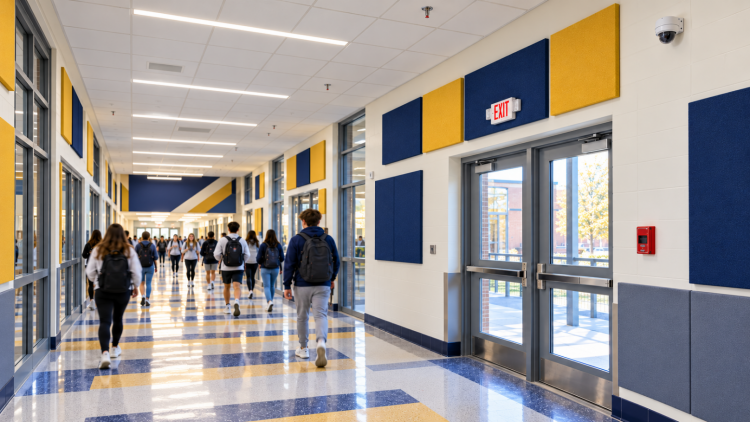
Library soundproofing keeps study zones quiet next to busy areas. Absorptive treatment in hallways stops class-change noise at classroom doors, and office soundproofing gives principals' and counseling offices the speech privacy they need.
Schools and Learning Spaces We Serve
Each type of school has its own approvals, budget cycle, and schedule, and we adapt to each.
K-12 Public, Private, and Charter Schools
Public schools get clear scopes and written estimates that fit district approvals. Private schools get finishes that suit their buildings, and charter schools in leased spaces get removable treatment that doesn't alter the structure.
Colleges and Universities
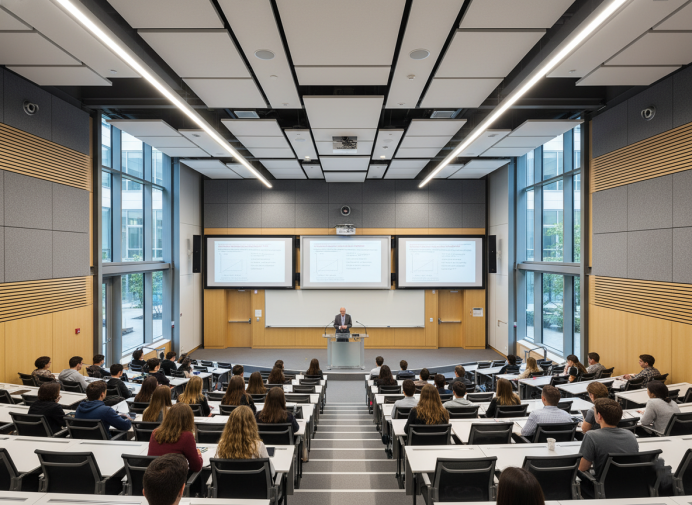
Seminar rooms and lecture halls need clear speech for discussion, recorded lectures, and video calls, with reverberation control that carries a lecturer's voice to the back rows. We also work with tutoring centers and educational nonprofits that share buildings with offices or retail.
Special Education and Early Childhood
Students with hearing impairments or auditory processing disorders depend on clear speech the most, so we target low background noise and short reverberation and can create calmer sensory rooms. For daycare and Pre-K rooms, we use durable, child-safe panels mounted out of reach.
Acoustic Design That Fits School Safety and Style
Panels and ceiling systems never block fire exits, alarms, sprinklers, cameras, or signage, and we plan placement around them from the start. Materials are chosen to handle daily wear, colors can match your school's branding, and where rooms may be reconfigured, we favor treatment that can be moved.
Our School Soundproofing Process
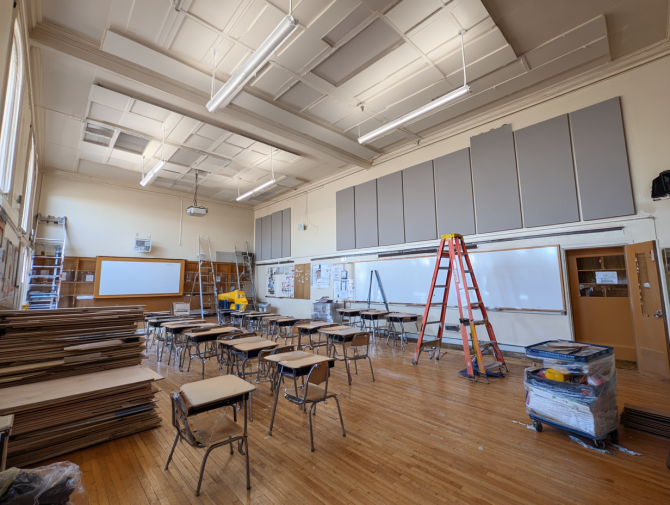
Every project is timed around your academic calendar.
- Consultation about the problem rooms, timeline, and budget.
- On-site measurements to set a baseline.
- Treatment design with a written estimate.
- Manufacturing in our New York shop to your rooms' exact dimensions.
- Installation during summer break, holidays, or after hours.
- Post-install measurements, shared with your team.

Service Area
We install across all five NYC boroughs, the Greater New York metro area, New Jersey, Greater Philadelphia, and Chicago, and ship custom acoustic panels nationwide. See our service area page for details.
Why Choose New York Soundproofing for School Acoustics
One team in New York City handles design, manufacturing, and installation, so a single company is responsible for the result. We bring decades of experience in commercial and institutional projects, and our education-sector clients include NYU, NYIT, and the City of New York. Every design is based on ANSI/ASA S12.60 targets and verified with measurements after installation. Panels can be matched to Pantone colors or printed with custom graphics, and the first on-site or virtual consultation is free and comes with a written estimate.

Get a Free School Acoustic Consultation
If noise is getting in the way of teaching, a short assessment will show where it comes from and how to fix it. Call (877) 999-2201 or fill out the form below. The first consultation is free.
FREQUENTLY ASKED QUESTIONS
How do you soundproof a classroom?
We measure first, then treat each path the noise takes: the shared wall, the door, the ceiling space above the partition, and any ductwork. Inside the room, acoustic panels and ceiling treatment reduce echo.
Do you serve schools outside of NYC?
Yes. Our installation service area includes the New York metro area, New Jersey, Philadelphia and Greater Philadelphia, and Chicago and the Greater Chicago metro. For projects outside that area, we ship custom-manufactured acoustic products nationwide.
Can panels be customized with school colors, logos, or student artwork?
Yes. We print directly onto acoustic panel fabric and match Pantone color references, which lets schools incorporate mascots, logos, school colors, and student-created artwork without compromising the panel's acoustic performance.
How long does a classroom soundproofing project take?
Project timing depends on the number of classrooms, the scope of treatment, and product lead times. A single classroom is typically installed in a few days; multi-room or multi-wing projects scale from there. We provide a specific timeline as part of the written estimate.
Can you install classroom soundproofing during summer break or after school hours?
Yes. We routinely schedule classroom installations during summer breaks, winter and spring breaks, weekends, evenings, and overnight windows. For occupied schools, we work in phased segments, classroom-by-classroom or wing-by-wing, to keep instruction running.
Are your acoustic panels fire-rated for schools?
Yes. The acoustic panels, baffles, and upholstery materials we install in classrooms and other public assembly spaces are specified to meet the fire-rating requirements that apply to those spaces. We confirm rating documentation as part of the design and submittal process.
How do you address HVAC and mechanical noise in classrooms?
HVAC noise in classrooms is reduced through duct silencers, lined ductwork, equipment isolation, and supply/return diffuser selection. The ANSI S12.60 background noise limit of 35 dBA is often the deciding constraint. We coordinate with the school's mechanical engineer or contractor when HVAC noise is part of the project scope.
How do you reduce noise between adjacent classrooms?
Reducing classroom-to-classroom transmission requires upgrading the wall assembly between the rooms, sealing doors and door undercuts, and addressing flanking paths through ceiling plenums or shared HVAC. Adding absorption inside the rooms by itself does not reduce transmission — the assemblies between rooms have to be addressed.
What's the difference between soundproofing and sound absorption for classrooms?
Soundproofing keeps sound from passing between rooms — for example, reducing transmission between adjacent classrooms or from corridors. It is measured by Sound Transmission Class (STC). Sound absorption reduces echo and reverberation inside the classroom by absorbing sound reflections off walls and ceilings. It is measured by Noise Reduction Coefficient (NRC) and reverberation time. Most classroom projects need both.
What is ANSI S12.60, and does it apply to my school?
ANSI/ASA S12.60-2010 is the US national standard for classroom acoustics. It sets reverberation time and background noise limits for typical learning spaces and is widely referenced by school districts, architects, and educational specifiers. Some states and districts adopt it directly; others reference it as a design guideline. We design classroom projects against its targets where applicable.
What's the ideal reverberation time for a classroom?
For most US classrooms — core learning spaces under 10,000 cubic feet — the recommended unoccupied reverberation time is 0.6 seconds or less, per ANSI/ASA S12.60-2010. Larger learning spaces have slightly higher allowable values. Untreated classrooms with hard floors and reflective walls often measure well above 1.0 seconds, which is why acoustic treatment is needed to meet the standard.
In this video New York Soundproofing demonstrates the dramatic difference before - and after - installing our acoustic panels. This acoustic treatment project was at the Galaxy Visuals video studio - a state-of-the-art video studio in Brooklyn, NY.
The video room was turned from acoustically unusable to sounding exceptional!
When our clients moved into the space, there was so much echo they couldn't do any video shoots with decent sound, or even understand each other speak.
New York Soundproofing to the rescue! We installed acoustic panels that matched the space and could fit in an area that is outside of the camera frame for a fantastic result. This is only one example of many where we transform an unusable space into a great-sounding room fit for recording, listening and more.
Contact us today to see how we can help transform your space! (Also see Galaxy's client testimonial video below).

New York's Soundproofing Experts
We specialize in creating highly-customized sound environments such as home offices, recording studios, home studios and music rooms, conference & teleconference rooms, bars and clubs, offices, restaurants, temples, churches, school auditoriums and much more.