Warehouse Soundproofing
Warehouses present three simultaneous acoustic challenges that each require a different treatment method. Hard reflective surfaces and large air volumes generate extreme reverberation that makes voice communication unreliable. Heavy equipment, forklifts, and conveyor systems produce both airborne and structure-borne noise that reaches dangerous levels under OSHA standards. Loading docks create direct openings for noise to escape the building and generate high-intensity impact noise through the floor structure. Unresolved warehouse noise is not only a productivity problem — it is a regulatory compliance issue under OSHA and a documented cause of workplace accidents.
Why Warehouses Are Among the Loudest Industrial Spaces
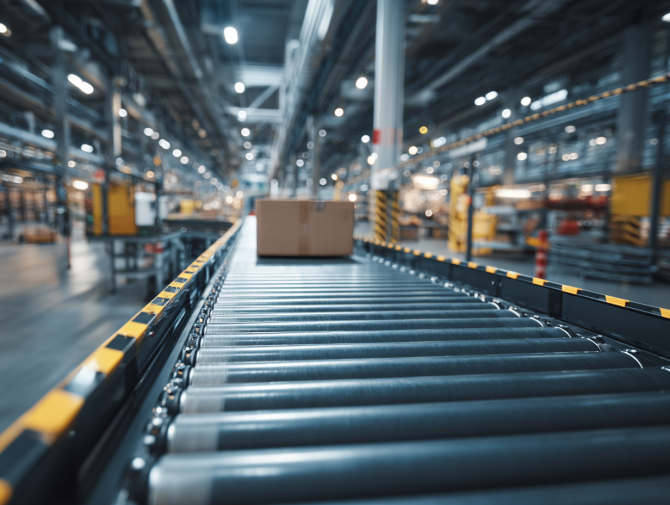
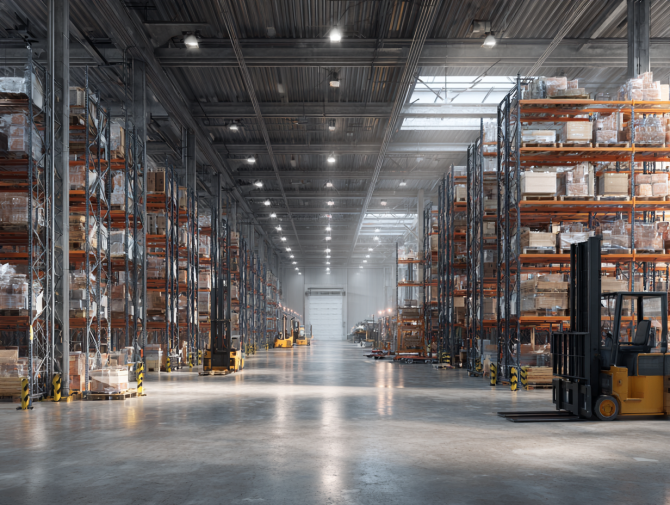
The acoustic difficulty of a warehouse is determined by three factors operating simultaneously: a large, partially empty volume with high ceilings, surfaces that are entirely hard and reflective — concrete floors, metal racking, masonry walls, and glazing — and continuous operation of heavy machinery. Unlike a manufacturing facility, a warehouse rarely contains soft furnishings, machinery housings, or dense equipment clusters that would naturally absorb sound energy.
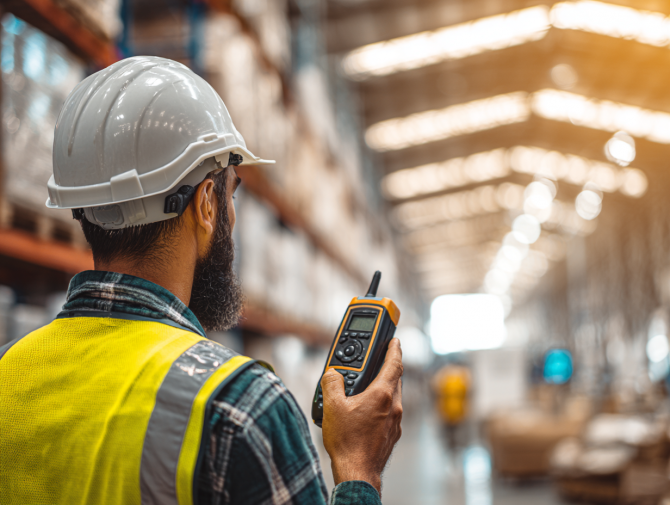
Reverberation time in an untreated warehouse typically measures 3–8 seconds (RT60). At these values, speech becomes unintelligible because each word continues to reflect through the space before the next word is spoken. Voice-based safety warnings from supervisors and forklift operators are not reliably perceived — OSHA identifies communication failure in loud environments as a contributing factor in warehouse workplace accidents.
OSHA establishes two noise exposure thresholds. The Action Level is 85 dB averaged over an 8-hour shift, requiring a mandatory hearing conservation program. The Permissible Exposure Limit (PEL) is 90 dB, above which engineering controls are required. Standard warehouse equipment routinely exceeds both thresholds: forklifts generate 80–95 dB, conveyor systems 85–100 dB, loading dock operations 85–95 dB.
Warehouse noise divides into two types that require different treatments. Airborne noise travels through the air from engines, conveyor drives, and HVAC systems. Structure-borne noise is mechanical vibration that transfers through the floor slab and building frame from forklifts, pallet impacts, and conveyor drives. Applying treatment for one type while ignoring the other produces incomplete noise reduction.
A third complicating factor is flanking noise — airborne sound that bypasses soundproofed walls by traveling through indirect paths: dock door gaps, unsealed wall penetrations, open plenum space above office partitions, and shared HVAC ductwork. Flanking is the most frequent reason a partial soundproofing installation underperforms. A well-constructed office wall with STC 50 can be rendered ineffective by a single unsealed gap above the ceiling line.
Our Warehouse Soundproofing Services
We provide acoustic treatment and soundproofing for warehouse facilities of all types and sizes — from small distribution centers to large multi-dock fulfillment operations. All projects include pre-installation noise measurements, engineered solution design, and professional installation by our own team.
We work with the following facility types:
- Distribution and fulfillment centers where forklift and conveyor noise exceeds OSHA action levels
- Cold storage warehouses where HVAC systems and compressor rooms create continuous high-level noise
- Manufacturing warehouses combining production and storage in a single structure
- Mixed-use industrial buildings where warehouse operations are adjacent to office, retail, or residential spaces
- E-commerce fulfillment facilities with high-density conveyor and sortation systems
OSHA compliance is a specific deliverable we can design for. When the project goal is to bring measured noise levels below a defined OSHA threshold — Action Level (85 dB) or PEL (90 dB) — we design the treatment to achieve that target and provide post-installation measurements that document the result. These measurements can be used as part of an employer's OSHA compliance documentation.
Our Process
Every warehouse soundproofing project begins with on-site noise measurement. Warehouse noise conditions vary significantly by zone, shift, and equipment mix. A measurement-based assessment identifies the specific sources, levels, and transmission paths that need to be addressed — and ensures the solution is matched to the actual conditions rather than a generic specification.
Noise Assessment
We measure sound pressure levels (dB) at worker positions throughout the facility, identify the primary noise sources and their dominant frequencies, and compare measured levels to OSHA Action Level and PEL thresholds. For facilities with in-warehouse offices, we also measure transmission levels inside enclosed spaces. The assessment report documents existing conditions by zone and identifies the treatment required in each area.
Solution Design
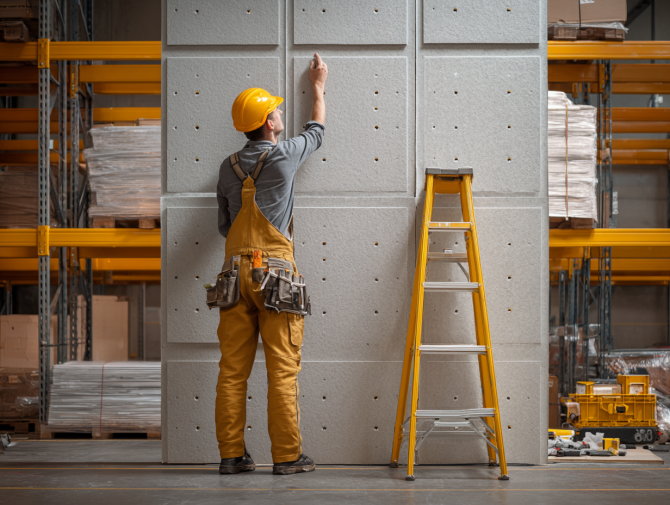
Based on measurement data, we develop a treatment plan that specifies ceiling baffle layout and coverage, wall panel zones, equipment isolation specifications, dock door and seal recommendations, and — where required — office wall assembly design. The design includes projected noise reduction by zone and confirms OSHA compliance targets where applicable. For operating facilities, the installation sequence is planned to minimize disruption to warehouse operations.
Installation and Verification
Installation is performed by our own team without subcontractors. After installation, we conduct noise measurements at the same positions used during the assessment and compare results to the pre-installation baseline. The post-installation report documents the achieved noise reduction in dB by zone and is provided to the client in writing. Where OSHA compliance is the project goal, the report format supports inclusion in the employer's hearing conservation program documentation.
Why Businesses Choose Us for Warehouse Soundproofing
Clients select us for warehouse projects based on four consistent factors: direct experience with large-volume industrial spaces, in-house manufacturing of acoustic materials, measurement-based project delivery, and the ability to produce OSHA-compliant documentation.
Experience with Large-Volume Industrial Spaces
Our team has completed acoustic treatment and soundproofing projects in distribution centers, manufacturing warehouses, cold storage facilities, and mixed-use industrial buildings. This range of project types covers the full variety of warehouse noise conditions — from high-reverberation empty-volume spaces to high-intensity conveyor and dock environments.
In-House Manufacturing of Acoustic Materials
We manufacture acoustic panels and baffles locally. In-house manufacturing allows us to produce materials to exact project dimensions, specify industrial-grade facings appropriate for dusty or high-impact environments, and meet fire rating requirements for the relevant occupancy classification.
OSHA-Compliant Project Documentation
For projects driven by OSHA requirements, we provide pre- and post-installation measurement reports in a format that supports employer compliance documentation. Reports include measured dB levels by zone, comparison to OSHA thresholds, and documentation of the engineering controls implemented.
Pre- and Post-Installation Noise Measurements
Every project includes noise measurements before work begins and after installation is complete. The pre-installation measurement establishes the baseline. The post-installation measurement documents the achieved noise reduction in dB. Both reports are provided to the client and create a verifiable record of the project's acoustic performance.

Schedule a Warehouse Noise Assessment
During the assessment visit, we measure sound pressure levels at worker positions throughout the facility, compare results to OSHA thresholds, and identify the primary noise sources and transmission paths. For facilities with in-warehouse offices, we measure interior levels in enclosed spaces to quantify transmission. The assessment produces a written report with zone-by-zone noise levels, OSHA compliance status, and recommended treatment options with projected noise reduction. There is no obligation to proceed.
FREQUENTLY ASKED QUESTIONS
How do loading docks contribute to warehouse noise problems?
Loading docks create two distinct noise problems. First, they are the primary path through which warehouse noise escapes to the exterior. Standard sectional dock doors provide STC 20–25 when closed, and no meaningful noise reduction when open. Second, forklift impact on dock leveler plates and trailer floors generates high-intensity impact noise that transmits through the floor slab into adjacent areas of the building. Both problems — exterior noise leakage and impact transmission — require separate treatments.
What STC rating do warehouse office walls need?
The required STC depends on the noise level in the warehouse and the target level inside the office. For a warehouse environment averaging 90 dB, achieving a standard office interior of 55 dB requires approximately 35 dB of noise reduction — a wall assembly with STC 45–50. Achieving a quieter dispatch or control room environment of 50 dB requires STC 50–55. These targets apply to the complete enclosure assembly, including ceiling barriers and door and window treatment. A high-STC wall without a ceiling barrier or with a standard door will not achieve the calculated target.
How do I reduce noise from a conveyor system?
Conveyor noise has two components that require separate treatment. Airborne noise from motor drives and roller contact is reduced with acoustic barriers alongside the conveyor run or partial enclosures over the noisiest sections. Structure-borne vibration from conveyor drives is reduced with vibration isolation mounts under the drive units. Treating only the airborne component while leaving drive vibration untreated will not achieve full noise reduction at worker positions adjacent to the conveyor.
Can warehouse soundproofing be installed without shutting down operations?
In most cases, yes. Ceiling baffle installation is performed from scissor lifts or aerial platforms during off-peak hours or over weekends without affecting floor operations. Wall panel installation requires access to the wall area but does not interrupt conveyor or forklift operations in adjacent zones. Equipment enclosure construction may require a brief shutdown of the specific machine being enclosed. The installation sequence is planned around the facility's operational schedule.
What is the most effective way to reduce noise in a large warehouse?
The most effective single intervention depends on the dominant noise source. For spaces where reverberation is the primary issue, ceiling baffles covering 15–25% of the ceiling area produce the largest reduction in overall noise levels with the least operational disruption. For spaces where specific equipment exceeds OSHA limits, vibration isolation at the source and equipment enclosures provides greater targeted reduction. Most warehouse projects require a combination of both approaches.
What is the OSHA noise limit for warehouse workers?
OSHA establishes two thresholds for occupational noise exposure. The Action Level is 85 dB averaged over an 8-hour shift, at which employers must implement a hearing conservation program including audiometric testing and hearing protection. The Permissible Exposure Limit (PEL) is 90 dB for an 8-hour shift, above which engineering controls — physical modifications to the work environment — are mandatory. Shorter exposure times allow higher levels: OSHA permits 100 dB for 2 hours and 110 dB for 30 minutes.
In this video New York Soundproofing demonstrates the dramatic difference before - and after - installing our acoustic panels. This acoustic treatment project was at the Galaxy Visuals video studio - a state-of-the-art video studio in Brooklyn, NY.
The video room was turned from acoustically unusable to sounding exceptional!
When our clients moved into the space, there was so much echo they couldn't do any video shoots with decent sound, or even understand each other speak.
New York Soundproofing to the rescue! We installed acoustic panels that matched the space and could fit in an area that is outside of the camera frame for a fantastic result. This is only one example of many where we transform an unusable space into a great-sounding room fit for recording, listening and more.
Contact us today to see how we can help transform your space! (Also see Galaxy's client testimonial video below).


New York's Soundproofing Experts
We specialize in creating highly-customized sound environments such as home offices, recording studios, home studios and music rooms, conference & teleconference rooms, bars and clubs, offices, restaurants, temples, churches, school auditoriums and much more.