Recording Studio Soundproofing
Soundproofing a recording studio involves two physically distinct tasks that are frequently confused. Sound isolation prevents sound from transferring through the walls, ceiling, and floor between the studio and the surrounding space. Acoustic treatment controls reflections and reverberation inside the room to produce a clean recorded signal. Both tasks are necessary, but they require different methods and different materials. The available methods also differ fundamentally depending on whether the studio is being built from scratch or retrofitted into an existing room.
Acoustic Treatment Methods for Recording Studios
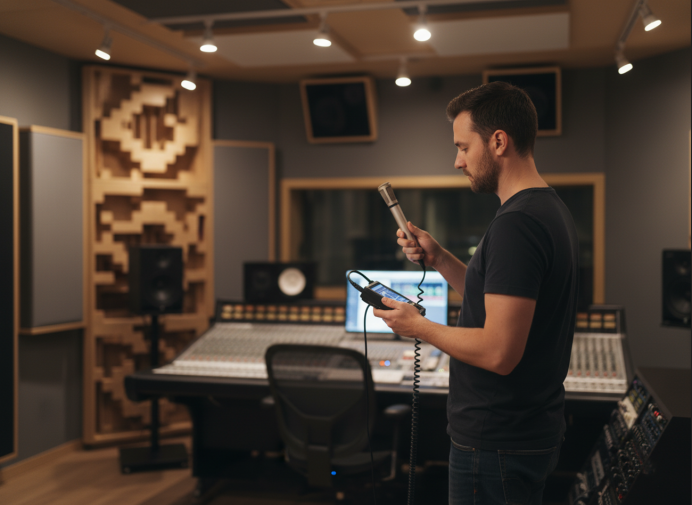
Acoustic treatment in a recording studio addresses three tasks: absorbing excess reflections to reduce reverberation time, scattering sound waves to prevent flutter echo, and controlling low-frequency buildup in room corners. A properly treated studio achieves RT60 of 0.3–0.5 seconds and an even frequency response across the recording space. Without acoustic treatment, even a well-isolated studio will produce recordings colored by room resonances and reflections.
Absorption Panels
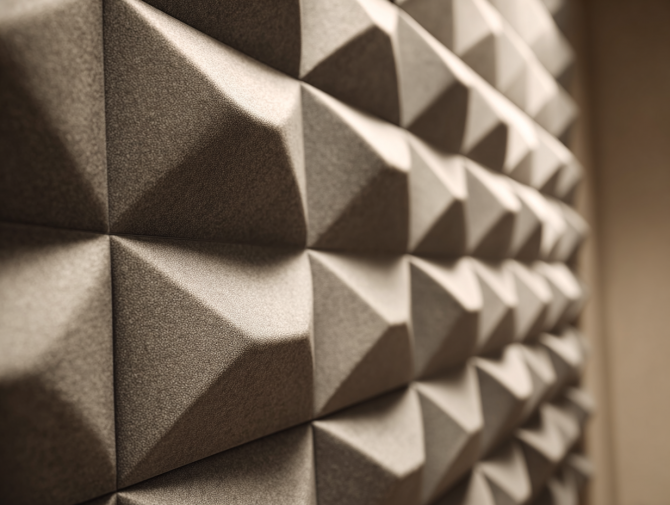
Absorption panels are constructed from porous materials — open-cell foam, fiberglass, or mineral wool — that convert sound energy to heat as air molecules move through the material under acoustic pressure. They are effective primarily in the mid and high frequency range.
The lower frequency limit of an absorption panel is determined by its thickness. A 2-inch foam or fiberglass panel is effective from approximately 500 Hz upward. A 4-inch panel absorbs effectively from approximately 250 Hz. Below 250 Hz, standard absorption panels have a negligible effect, and low-frequency control requires dedicated bass traps.
Absorption panels are placed at first reflection points — the locations on walls, ceiling, and floor where sound from the monitor speakers reaches after a single reflection before arriving at the mix position. On the side walls, this is approximately halfway between the monitors and the listening position. On the ceiling, it is the point directly above the listening position. Treating first reflection points reduces comb filtering at the mix position, improving frequency response accuracy.
Bass Traps
Bass traps are thick, dense absorbers designed specifically for the low-frequency range of 63–250 Hz. They are installed in room corners — the intersections of two walls, or a wall and the ceiling or floor.
Corner placement is the most effective position for bass traps because low-frequency pressure builds up at structural boundaries. At the point where two walls meet, pressure is twice the room's average. At the tri-corner where two walls and a ceiling or floor intersect, pressure is approximately eight times the room average. Installing bass traps floor-to-ceiling in all four vertical room corners and at the ceiling-wall junctions targets the zones where low-frequency energy concentrates most heavily.
Without bass traps, low-frequency room modes — resonances at frequencies related to the room dimensions — cause certain bass notes to appear louder or quieter than others at the mix position. This makes accurate bass mixing impossible, and recordings made in such rooms will have uneven low-end when played back on neutral systems.
Diffusion Panels
Diffusion panels scatter incoming sound waves in multiple directions rather than absorbing them. They are used on the rear wall of a recording studio — behind the listening position — to prevent focused reflections returning directly from the back wall to the mix position.
The practical difference between absorption and diffusion is the acoustic character of the treated space. Absorption removes reflections entirely, reducing reverberation time. Diffusion spreads reflections in time and direction, maintaining a sense of acoustic space while eliminating direct echoes. A studio treated entirely with absorption becomes acoustically "dead" — recordings made in it lack natural ambience and feel unnaturally compressed. The standard approach is absorption at first reflection points combined with diffusion at the rear wall, producing a front-dead, rear-diffuse acoustic environment appropriate for mixing and tracking.
Our Recording Studio Soundproofing Services
We provide sound isolation and acoustic treatment for recording studios across all project types — from commercial professional studios requiring full room-within-a-room construction to home studio retrofits in residential buildings. All projects include pre-installation acoustic measurements, solution design targeting specific STC and NC values, material supply, and professional installation.
We work with the following studio types:
- Professional and commercial recording studios requiring NC-15 to NC-20 and full room-within-a-room design
- Project and semi-professional studios in commercial or mixed-use buildings
- Home studios in detached houses where retrofit construction achieves STC 50–55
- Home studios in apartments with noise isolation constraints from adjacent units
- Voiceover and podcast booths for corporate, broadcast, and independent production
- Broadcast and radio studios with specific background noise and isolation requirements
- Rehearsal rooms where isolation from adjacent commercial or residential spaces is the primary need
We manufacture acoustic panels and baffles in-house, which allows us to produce materials to the exact dimensions required by each project and to specify panel performance — NRC, thickness, facing material — matched to the acoustic targets of the space.
Our Process
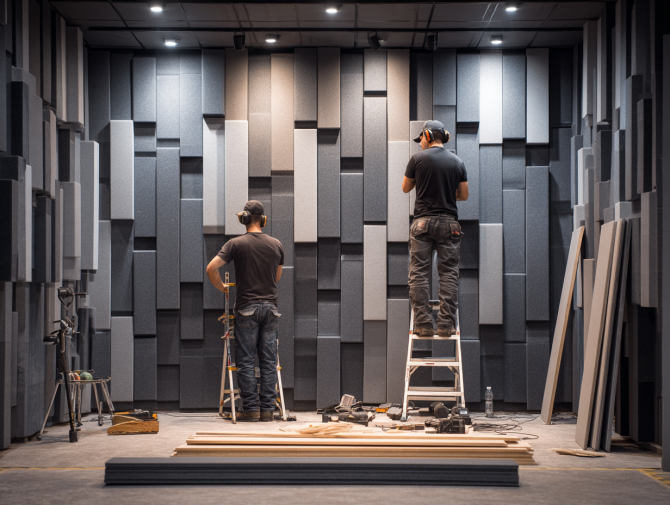
Every studio project begins with on-site measurement. Studio acoustic conditions depend on room geometry, existing construction type, and the specific noise sources present in and around the building. A measurement-based design process produces a solution matched to the actual conditions rather than a generic specification.
Acoustic Assessment
We measure RT60 at multiple positions within the studio space, background noise levels (NC rating) with the HVAC system operating, and external noise levels at the building envelope. For retrofit projects, we also measure the existing wall STC performance using source and receiver level measurements across frequency bands. The assessment report documents baseline conditions and identifies the specific isolation and treatment required to reach the target NC.
Solution Design
Based on measurement data, we design the complete treatment plan: wall assembly specification with projected STC by frequency band, acoustic panel layout with RT60 modeling, bass trap placement, door and window treatment, HVAC silencer sizing, and — where required — floating floor design. The design documents the projected performance of each element and the expected composite NC inside the finished studio. For projects in occupied buildings, the installation sequence is planned to minimize disruption.
Installation and Verification
Installation is performed by our own team. After completion, we conduct RT60 and NC measurements at the same positions used during the assessment. The post-installation report documents the achieved RT60, the achieved NC rating, and — where wall STC was the primary target — the measured transmission loss across frequency bands. Both the pre- and post-installation reports are provided to the client as a verifiable record of acoustic performance.
Why Choose Us for Recording Studio Soundproofing
Clients select us for studio projects based on three factors that directly affect whether a project reaches its acoustic targets: experience with the specific construction conditions that studio soundproofing requires, the ability to manufacture acoustic materials to project specifications, and a measurement-based delivery process that documents results objectively.
Experience with Professional and Home Studio Projects
Our team has completed soundproofing and acoustic treatment projects across the full range of studio types — from commercial multi-room recording facilities to home studio retrofits in apartments and detached houses. This range of experience covers the specific construction conditions, noise sources, and performance targets that differ significantly across studio types.
In-House Manufacturing of Acoustic Panels and Baffles
We manufacture acoustic panels locally. In-house production allows us to match panel dimensions precisely to the room geometry, specify the correct absorber thickness for the frequency range that needs treatment, and select facing materials — fabric, perforated metal, or sealed fiberglass — appropriate for the studio's acoustic and visual requirements.
Pre- and Post-Installation Acoustic Measurements
Every project includes acoustic measurements before and after installation. Pre-installation measurements establish the baseline RT60 and NC. Post-installation measurements document what was achieved. Clients receive both reports in writing. The measurements create an objective record of the project's acoustic performance that is independent of subjective assessment.
Schedule a Recording Studio Acoustic Assessment
During the assessment visit, we measure RT60, NC, and external noise levels at your studio location and evaluate the existing construction for its current and potential STC performance. For new construction projects, we assess the site conditions and structural type to confirm achievable isolation targets. The assessment produces a written report with baseline acoustic data, recommended treatment approach, and projected performance targets. There is no obligation to proceed.
FREQUENTLY ASKED QUESTIONS
What is the difference between a home studio and a professional studio in terms of soundproofing requirements?
A professional studio targets NC-15 to NC-20 and requires STC 60–70 — achievable only through room-within-a-room construction with a floating floor. A home studio targets NC-25 to NC-35 and requires STC 50–55 — achievable by retrofitting existing rooms with decoupled drywall and MLV. The acoustic treatment methods are similar for both; the difference is in isolation level and construction method.
How do I reduce HVAC noise in a recording studio?
Studio HVAC noise enters through two paths: airborne noise through ductwork, and structural vibration from fans and compressors through the building frame. Airborne duct noise is controlled with acoustic duct silencers installed where ducts enter the studio. Structural vibration is controlled by mounting all HVAC equipment on isolation pads or spring hangers. Air velocity at the supply diffuser must stay below 300 feet per minute to prevent audible airflow noise.
What is a room-within-a-room and when is it necessary?
A room-within-a-room is an inner studio shell — walls, ceiling, and floor — built as a structurally independent structure with no rigid contact with the outer building. Sound must cross the air gap between the two shells without a direct physical path, which eliminates vibration transmission. It is required for professional studios targeting NC-20 or lower, and for any studio recording drums, bass amplifiers, or orchestral instruments. Home studios and voiceover booths can achieve their targets with decoupled retrofit construction.
Why do low frequencies require special treatment in studios?
Bass frequencies in the 63–250 Hz range pass through standard wall assemblies with far less attenuation than mid and high frequencies. The standard STC rating understates this — it is calculated from 125–4000 Hz and is weighted toward mid frequencies. Additionally, low frequencies accumulate in room corners, creating resonances that produce uneven frequency response at the mix position. Both problems require dedicated treatment: room-within-a-room construction for isolation and bass traps for room modes.
Can I soundproof a recording studio without construction?
Partial improvements are possible. Decoupled drywall on resilient clips raises wall STC from 33–37 to 45–50. Acoustic door seals and automatic bottom sweeps improve door STC from 20–25 to 35–40. Bass traps and absorption panels require no structural work. Achieving STC 60+ for professional-grade isolation requires full room-within-a-room construction and cannot be retrofitted without rebuilding walls and floors.
What STC rating do recording studio walls need?
Professional studios targeting NC-15 to NC-20 require STC 60–70 — achievable only with room-within-a-room construction. Home studios targeting NC-25 to NC-35 require STC 50–55, achievable with decoupled retrofit. Voiceover booths targeting NC-35 to NC-40 require STC 40–50, achievable with a prefab booth or single decoupled wall layer. The exact target is calculated by measuring external noise and subtracting the target NC.
What is the difference between soundproofing and acoustic treatment for a recording studio?
Sound isolation prevents noise from passing through walls, floors, and ceilings — measured in STC. Acoustic treatment controls how sound behaves inside the room: reverberation, reflections, and bass buildup — measured in RT60 and NC. They address separate problems with separate methods. Both are required for a functional recording studio.
In this video New York Soundproofing demonstrates the dramatic difference before - and after - installing our acoustic panels. This acoustic treatment project was at the Galaxy Visuals video studio - a state-of-the-art video studio in Brooklyn, NY.
The video room was turned from acoustically unusable to sounding exceptional!
When our clients moved into the space, there was so much echo they couldn't do any video shoots with decent sound, or even understand each other speak.
New York Soundproofing to the rescue! We installed acoustic panels that matched the space and could fit in an area that is outside of the camera frame for a fantastic result. This is only one example of many where we transform an unusable space into a great-sounding room fit for recording, listening and more.
Contact us today to see how we can help transform your space! (Also see Galaxy's client testimonial video below).

New York's Soundproofing Experts
We specialize in creating highly-customized sound environments such as home offices, recording studios, home studios and music rooms, conference & teleconference rooms, bars and clubs, offices, restaurants, temples, churches, school auditoriums and much more.