
Office Soundproofing
Office noise falls into two categories that need separate solutions: sound passing between enclosed spaces, and sound building up inside a shared space. Treating one does not fix the other. Sound passing between spaces is a transmission problem. Voices carrying from a private office, conference room, or HR area into neighboring rooms are a failure of blocking, not of decoration.
Sound building up inside a space is a reflection problem. Open-plan floors feel loud because hard surfaces bounce voices and equipment noise around the room, raising the overall level and destroying concentration. Speech privacy is a third, related concern. Confidential conversations in meeting rooms, HR, and executive offices can remain intelligible in adjacent spaces even when a wall looks solid, because gaps, shared ceiling plenums, and low background sound let speech carry.
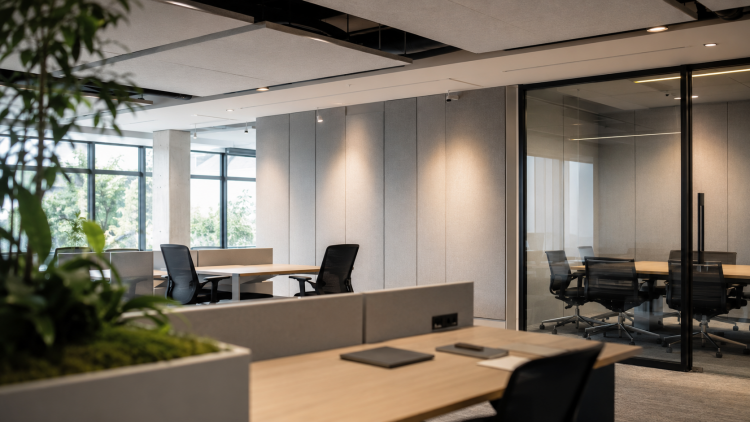
Soundproofing vs Sound Absorption in Offices
Soundproofing and sound absorption are different acoustic strategies that solve different problems, and confusing them is the most common reason office acoustic projects fail.
Soundproofing blocks sound from passing between spaces. It relies on mass, sealing, and decoupling, and its performance is measured by Sound Transmission Class (STC) - a higher STC means more sound is blocked between rooms.
Sound absorption reduces echo and reverberation within a single space. It relies on soft, porous materials such as acoustic panels and baffles, and its performance is measured by Noise Reduction Coefficient (NRC) on a 0 to 1 scale - a higher NRC means more sound is absorbed inside the room.
Absorption alone does not stop sound from traveling between rooms. Adding acoustic panels to a wall reduces echo in that room but does little to keep a conversation from being heard next door, which requires blocking.
Most offices need both. Enclosed offices and conference rooms need blocking (STC) for privacy, while open-plan floors need absorption (NRC) and often sound masking to control the overall noise level.

Our Office Soundproofing Services
Our office soundproofing services cover both blocking and absorption, matched to whether the problem is sound leaking between rooms or noise building up within a space. Each service below targets a specific office noise problem.
Private Office Wall and Ceiling Soundproofing
Wall and ceiling soundproofing blocks sound transmission into and out of private offices by adding mass, sealing gaps, and treating shared ceiling plenums. It raises the STC between spaces so conversations stay contained, which is the foundation of office privacy.
Conference Room and Meeting Confidentiality
Conference room treatment combines blocking and background sound to keep meetings confidential. It addresses the walls, doors, and ceiling path together because a high-STC wall does not provide privacy if sound leaks over the wall through a shared drop ceiling. (Internal link: dedicated Conference Room Soundproofing page.)
Open-Plan Acoustic Treatment
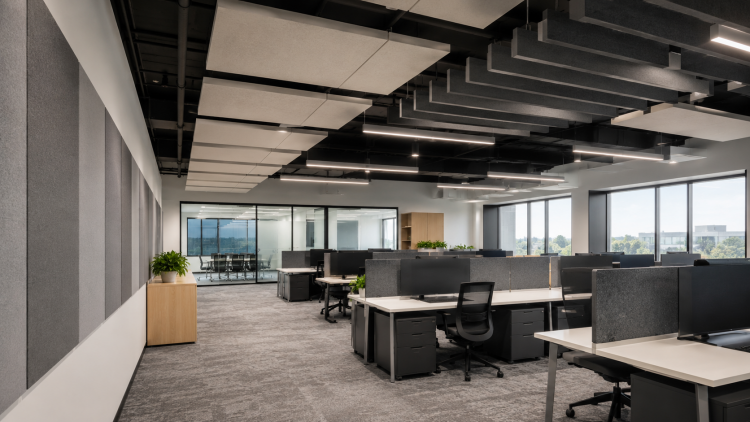
Open-plan treatment uses absorptive panels, baffles, and ceiling clouds to reduce echo and lower the overall noise level on a shared floor. High-NRC materials cut reverberation, so voices do not build up across the space, improving concentration.
Sound Masking Systems
Sound masking adds a low, engineered background sound distributed through the ceiling to reduce how far speech carries. By raising the background level in a controlled way, it lowers speech intelligibility between workstations and outside meeting rooms, improving privacy without making the office louder.
Why Choose Our Office Soundproofing Company
Effective office soundproofing depends on correctly diagnosing whether a problem needs blocking, absorption, or masking, and on treating the flanking paths that undermine most office acoustic work.
Licensed Installers with Decades of Commercial Acoustic Experience
Our installers are licensed and have spent decades on commercial acoustic and soundproofing projects. That experience encompasses both blocking and absorption, so the treatment is designed around sound-engineering principles rather than a single product line.
The Right Fix Diagnosed: Blocking vs Absorption
We identify whether each area needs blocking, absorption, or masking before specifying anything. This prevents the common and costly mistake of installing absorptive panels to solve a sound-transmission problem they cannot fix.
In-House Manufactured Acoustic Materials
We manufacture acoustic materials in New York City and select each product to fit the measured problem. This control lets us match STC and NRC performance to the specific area, rather than forcing a single solution across every office.
After-Hours Installation, Minimal Business Disruption
We schedule installation around your operations, including after hours and weekends, to keep the office running. Minimizing downtime is treated as part of the project scope, not an afterthought.
Our Office Soundproofing Process
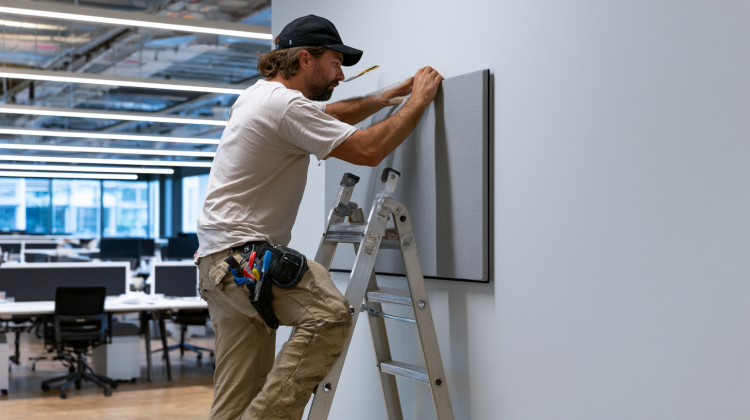
Our process moves from measurement to a verified result in four stages, so each area is treated for its actual acoustic problem rather than based on a general assumption.
On-Site Noise and Speech-Privacy Assessment
We measure noise levels and assess speech privacy across enclosed rooms and open areas. This establishes where the problem is transmission between spaces and where it is reverberation within a space.
Solution Design with STC and NRC Targets
We set STC targets for spaces that need blocking and NRC targets for spaces that need absorption. Defining measurable targets ensures each area is treated to a standard rather than by guesswork.
Installation with Minimal Downtime
We install blocking, absorptive, and masking systems on a schedule that minimizes business interruption. Flanking paths such as ceiling plenums and gaps are sealed as part of the work.
Verification and Sound Measurement
We measure noise and privacy after installation and compare the results to the baseline. This confirms the real-world improvement rather than relying solely on a material's lab rating.

How Much Noise Reduction to Expect
Office soundproofing yields measurable results, but the outcome depends on the problem being addressed and whether flanking paths are addressed, not on the word "soundproof."
Blocking between rooms is governed by STC and by sealing. A standard interior wall performs poorly for privacy, while confidential speech privacy generally requires higher assemblies, roughly STC 50 and above, combined with a solid ceiling path and sealed gaps.
Absorption in an open-plan space is governed by NRC and the amount of surface area treated. High-NRC panels and baffles reduce reverberation and lower the overall level, but they do not create silence and do not block sound between rooms.
Flanking paths limit real-world results. In offices with shared drop ceilings and open plenums, sound travels over walls through the ceiling, so a high-STC wall underperforms unless the ceiling path is treated.
Low-frequency noise is the hardest to control. HVAC rumble and mechanical noise carry long sound waves that require more mass and decoupling than mid- and high-frequency speech.

Schedule Your Office Soundproofing Today
Office soundproofing starts with an on-site assessment that separates transmission problems from reverberation problems and sets measurable STC and NRC targets. From there, we design, install, and verify a solution matched to each area.
📞 Call Now to book your assessment, or Request Your Free Quote to get an office soundproofing plan for your workplace.
FREQUENTLY ASKED QUESTIONS
Can an office be soundproofed while it stays in use?
Yes. Work can be scheduled after hours and in phases to limit disruption. Many blocking and absorption treatments are installed with minimal downtime to keep the business operating.
What is sound masking, and does an office need it?
Sound masking is a low, engineered background sound distributed through the ceiling that reduces speech intelligibility. Offices with open plans or privacy-sensitive rooms benefit from it because it lowers how far conversations carry without making the space louder.
How do you keep conference room conversations private?
Meeting confidentiality requires both a high-STC wall assembly and treatment of the ceiling path and door, plus adequate background sound. A solid-looking wall alone does not deliver privacy if sound flanks over it through a shared drop ceiling.
How do you make an open-plan office quieter?
Open-plan noise is best controlled with absorption and sound masking rather than blocking. Absorptive panels and baffles cut reverberation, while sound masking raises the background level in a controlled way to reduce how far speech carries.
Do acoustic panels soundproof an office?
No, not on their own. Acoustic panels absorb sound and reduce echo within a room, but they do not block sound from traveling to the next room. Stopping sound between spaces requires added mass, sealing, and treatment of the ceiling path.
What is the difference between office soundproofing and sound absorption?
Soundproofing blocks sound from passing between rooms and is measured by the STC rating. Sound absorption reduces echo within a room and is measured by NRC. Blocking delivers privacy between spaces, while absorption lowers noise buildup inside a space, and most offices need both.

New York's Soundproofing Experts
We specialize in creating highly-customized sound environments such as home offices, recording studios, home studios and music rooms, conference & teleconference rooms, bars and clubs, offices, restaurants, temples, churches, school auditoriums and much more.