Soundproofing a ceiling from noisy neighbors requires combining four physical principles - mass, absorption, decoupling, and damping - applied to either the existing ceiling surface or a newly built ceiling assembly below it. The right approach depends on the type of noise you hear (airborne versus impact), whether you own or rent, and your budget. This guide walks through three proven methods, expected decibel reductions, US material costs, and the mistakes that cause most ceiling soundproofing projects to fail.
Identify the Type of Noise Coming Through Your Ceiling

Two types of noise travel through a ceiling, and each requires a different soundproofing strategy. Diagnosing your noise correctly is the first step - soundproofing for the wrong type wastes money and produces no audible improvement.
Airborne noise
Airborne noise is sound that travels through the air before reaching the ceiling. Voices, TV audio, music, and barking dogs are airborne noise. It is the easiest type to reduce because it can be blocked by adding mass and absorption.
Impact noise
Impact noise is sound created when an object strikes the floor above and travels through the building structure as vibration. Footsteps, dropped objects, dragged chairs, and a child running across the floor are impact noise. It is harder to stop on the ceiling side because the vibration travels through solid joists and framing rather than through air.
A quick diagnostic: if the sound is muffled and you mostly hear low rumble and thumps, it is impact noise. If you can make out words, melodies, or TV dialogue, it is airborne noise. Most real-world situations involve both, but one type usually dominates.
Impact noise has an important consequence for expectations. The most effective fix for impact noise is at the source - the floor above - using thick rug pads, area rugs, or an underlayment under the upstairs flooring. From the ceiling side, only a fully decoupled assembly meaningfully reduces impact sound.
How Ceiling Soundproofing Works - The Four Core Principles
Every effective ceiling soundproofing project combines four principles. A single product or single technique rarely produces noticeable results - the principles compound.
Mass Blocks Sound by Adding Density
Mass blocks sound by making the ceiling heavier and denser. Heavy materials such as 5/8" Type X drywall, mass-loaded vinyl (MLV), and acoustic plasterboard force sound waves to expend energy moving the material, which reduces the sound that passes through.
Absorption Soaks Up Sound Inside the Joist Cavity
Absorption converts sound energy into heat inside the ceiling cavity. Mineral wool batts and acoustic insulation placed between joists absorb sound waves bouncing inside the cavity and stop the cavity from amplifying noise like a drum.
Decoupling Breaks Direct Contact Between Drywall and Joists
Decoupling separates the new ceiling surface from the joists above, preventing vibration from traveling directly through direct contact. Sound isolation clips (RSIC clips) and resilient channels create a small gap between the drywall and the structure, breaking the vibration path.
Damping Dissipates Vibration Between Drywall Layers
Damping dissipates sound energy as it tries to pass through layered surfaces. Green Glue and similar damping compounds are applied between two layers of drywall and convert vibrational energy into low-level heat, sharply reducing transmission.
The best results come from using all four together. Most failed projects use only one - usually mass alone - and produce a barely noticeable improvement.
Three Methods to Soundproof a Ceiling from Noisy Neighbors
There are three practical paths to soundproof a ceiling from upstairs neighbors, sorted by effort and effectiveness: adding mass to the existing ceiling, building a fully decoupled assembly, or using non-construction renter options. The right choice depends on ownership status, the dominant noise type, and budget.
Method 1 - Add Mass to the Existing Ceiling (No Demolition)
This method adds a second layer of dense material directly over the existing ceiling without removing any drywall. Choose it if you own the property, hear mostly voices, TV, or music from above, and want to avoid a full demolition. Realistic expectation is 5-10 dB of airborne noise reduction; impact noise will not improve significantly.
- Apply Green Glue damping compound (two 28 oz tubes) to the back of a new 5/8" Type X drywall sheet in a snake pattern.
- Lift and screw the sheet into the joists through the existing ceiling with 2½" coarse drywall screws spaced 12" along joists.
- Stagger the seams at least 16" from the original ceiling seams.
- Seal the perimeter with acoustic sealant (such as OSI Pro-Series SC-175).
- Tape, mud, prime, and paint.
A finished assembly reaches roughly STC 39-43 from a starting STC of 33-35. Conversations become muffled rather than intelligible, but footsteps will still come through because the joists remain hard-coupled to the new ceiling.
Method 2 - Build a Decoupled Acoustic Ceiling (Most Effective)
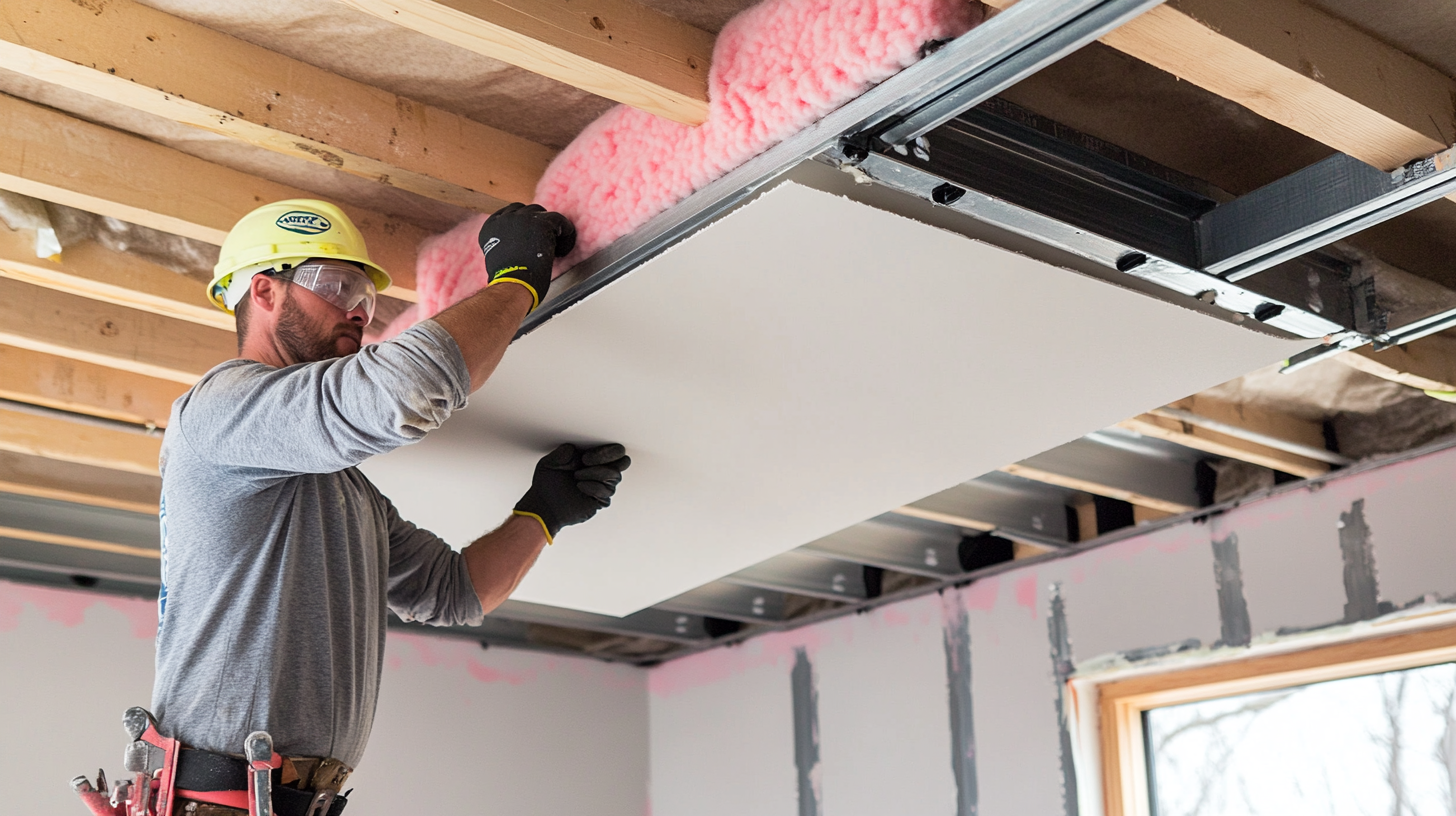
This is the most effective ceiling soundproofing method available to a homeowner. It removes the existing ceiling, fills the joist cavity, decouples the new surface from the structure, and double-layers dense drywall with a damping compound. Choose it if you own the property, deal with both airborne and impact noise, and can give up 2-3 inches of head height. Realistic expectation is 15-25 dB of overall reduction, reaching STC 56-62 and IIC 50+.
- Remove the existing ceiling drywall down to bare joists.
- Friction-fit Rockwool Safe'n'Sound or mineral wool batts between every joist cavity, filling full depth without compression.
- Mount RSIC-1 sound isolation clips on the underside of the joists at 24" spacing along and 48" across.
- Snap hat channels (furring channels) into the clips perpendicular to the joists.
- Screw the first layer of 5/8" Type X drywall into the channels only - never into the joists, or decoupling is defeated.
- Apply Green Glue (two 28 oz tubes per sheet) to the back of the second drywall layer.
- Install the second layer of 5/8" Type X with seams offset from the first.
- Seal the perimeter and every penetration (lights, HVAC) with acoustic sealant.
Most household noise from upstairs becomes barely perceptible at this performance level. Recessed lighting must be replaced with low-profile or surface-mount fixtures, and the work typically requires a contractor or an experienced DIYer with a drywall lift.
Method 3 - Rental-Friendly Options Without Construction
Renters and budget-limited owners can reduce ceiling noise without removing drywall or installing permanent assemblies. These options produce 3-8 dB of improvement, require no landlord approval, and need no demolition.
The single most effective action is to ask the upstairs neighbor to add a thick area rug with a dense rug pad. Impact noise drops sharply at the source, and a quality rug pad can outperform any ceiling-side treatment short of full decoupling. If the unit has a drop ceiling, mass-loaded vinyl laid above STC-rated acoustic tiles adds real mass and delivers 5-8 dB of airborne improvement. A white noise machine alongside any of these raises the room's noise floor so intermittent neighbor noise becomes less perceptible.
Acoustic foam panels mounted to the ceiling do not block sound from above - they reduce echo only inside your own room. Spending money on foam expecting it to stop upstairs footsteps is the most common DIY mistake in this space.
Materials, Costs, and Expected Performance
Ceiling soundproofing materials are widely available in the US at Home Depot, Lowe's, Amazon, and acoustic specialty suppliers (Soundproof Cow, Acoustical Solutions, Trademark Soundproofing). The table below summarizes total cost, decibel reduction, and difficulty for each method; prices are typical 2025-2026 ranges.
|
Method |
Cost per sq ft (materials) |
Expected dB Reduction |
DIY Difficulty |
Approx Final STC |
|
Method 1 - Add Mass |
$4-7 |
5-10 dB |
Moderate |
39-43 |
|
Method 2 - Decoupled Ceiling |
$10-18 |
15-25 dB |
Hard |
56-62 |
|
Method 3 - Rental-Friendly |
$1-3 |
3-8 dB |
Easy |
35-38 |
A useful rule for reading the numbers: every 10 dB of reduction is perceived as roughly half the loudness. A 20 dB drop - typical of Method 2 - is perceived as a four-fold reduction in volume. A 5 dB drop is noticeable but modest. Below 3 dB, most people cannot distinguish the difference.
For a 12'×12' room (144 sq ft), expect material totals of roughly $400-700 for Method 1, $1,500-2,500 for Method 2, and $100-400 for Method 3.
The individual materials that make up these assemblies are listed below with their function and typical US price.
|
Material |
Purpose |
Typical US Price |
DIY-Friendly |
|
5/8" Type X drywall (4'×8' sheet) |
Mass |
$14-22 per sheet |
Yes |
|
QuietRock EZ-Snap |
Mass + built-in damping |
$55-80 per 4'×8' sheet |
Yes |
|
Mass-Loaded Vinyl (1 lb/sq ft) |
Mass barrier |
$1.80-2.50 per sq ft |
Moderate |
|
Green Glue Noiseproofing Compound |
Damping (between drywall layers) |
$20-25 per 28 oz tube |
Yes |
|
Rockwool Safe'n'Sound R-12 |
Absorption (in joist cavity) |
$55-70 per bag (~60 sq ft) |
Yes |
|
Mineral wool batts (general) |
Absorption |
$1.00-1.50 per sq ft |
Yes |
|
RSIC-1 Sound Isolation Clips |
Decoupling |
$4-6 per clip |
Moderate |
|
Hat channels (resilient channels) |
Decoupling support |
$7-12 per 10 ft channel |
Yes |
|
OSI Pro-Series SC-175 acoustic sealant |
Air-seal |
$10-14 per 28 oz tube |
Yes |
Which Method Is Right for You?
The choice between methods comes down to three factors: ownership status, the dominant type of noise, and available budget.
If you rent, use Method 3 plus a polite conversation with the upstairs neighbor about a rug and rug pad. Avoid spending more than a few hundred dollars on temporary acoustic treatments.
If you own and hear mostly airborne noise (voices, TV, music), Method 1 delivers the best return. A second layer of 5/8" drywall with Green Glue is achievable as a weekend project and meaningfully improves comfort.
If you own and hear both airborne and impact noise, only Method 2 will produce a transformative result. Plan for a 2-3 inch ceiling drop, budget $1,500-2,500 in materials for a typical room, and consider hiring a contractor.
When to Bring in an Acoustic Professional
If the noise is unusually severe, if the building has structural quirks (steel joists, concrete planks, exposed mechanicals), or if you have already attempted one method and seen no improvement. A site assessment by an acoustic consultant typically costs $300-600 and prevents expensive trial-and-error.