
Hotel rooms are susceptible to two fundamentally different types of noise: airborne noise and impact noise. Airborne noise travels through the air and penetrates walls, doors, and windows - voices from adjacent rooms, television sound, street traffic, and HVAC systems all fall into this category. Impact noise is caused by physical vibration transmitted through the building structure - footsteps on the floor above, slamming doors, and plumbing are common examples.
Identifying the type of noise matters because the solutions differ. Airborne noise is addressed by adding mass and density to surfaces such as walls, doors, and windows. Impact noise requires decoupling the surface from the structure, typically using resilient channels, floating floors, or acoustic underlayment.
Hotel rooms in the US are typically built to a minimum STC (Sound Transmission Class) rating of 45-50 between guest rooms, per IBC requirements. At STC 45, a loud voice in the adjacent room is still audible; at STC 50, it becomes faint. Budget and mid-range hotels frequently fall below this threshold.
The most common noise entry points in a hotel room are: the gap under the door, hollow-core doors, single-pane or poorly sealed windows, thin partition walls between adjoining rooms, and shared HVAC ductwork.
Quick Soundproofing Fixes for Hotel Guests (No Tools, No Modifications)
Hotel guests cannot modify the room structure, but several non-invasive methods can significantly reduce perceived noise and improve sleep quality.
Request a room change
The most effective first step is to ask the front desk for a room away from the elevator bank, the street-facing side, or occupied adjacent rooms. Interior-courtyard rooms on higher floors consistently experience less external noise and are worth requesting at booking.
Use a white noise machine or app
White noise does not block sound - it masks it by raising the ambient noise floor, making sudden sounds less jarring. A free smartphone app or portable device set to fan noise or pink noise is effective for most intermittent noise sources, such as corridor voices and street traffic.
Place a rolled towel or portable door draft stopper at the base of the door
The gap under a hotel room door is one of the most significant entry paths for corridor sound. A rolled bath towel pressed firmly against the base reduces corridor noise noticeably without any tools or modifications.
Use noise-canceling headphones or earplugs
Active noise-canceling (ANC) headphones are highly effective against low-frequency continuous noise such as HVAC and traffic. Foam earplugs provide 25-33 dB of passive attenuation and are the most practical option for sleeping.
Close the blackout curtains fully
Hotel blackout curtains are heavier than standard curtains and provide a marginal but measurable additional layer of sound absorption at the window surface, reducing high-frequency reflections from outside.
Portable Soundproofing Products You Can Bring to a Hotel Room
A small set of travel-friendly products can meaningfully improve the acoustic quality of a hotel room without any permanent modifications.
Portable white noise machine
Dedicated devices such as the LectroFan or Marpac Dohm produce higher-quality masking sound than phone speakers and run on USB power. They are effective for masking airborne noise from corridors and adjacent rooms throughout the night.
Travel door seal kit
Several manufacturers produce adhesive-backed foam strips and portable door sweeps designed for temporary door soundproofing installation. They seal the perimeter gap of a hotel room door without leaving permanent marks, targeting the gap beneath and around the door frame, which accounts for a substantial portion of corridor noise infiltration.
Acoustic earmuffs vs. noise-canceling headphones
Passive acoustic earmuffs (NRR 25-33) provide consistent attenuation across all frequencies and require no charging. Noise-canceling headphones outperform them on low-frequency noise below 500 Hz but are less effective for mid- and high-frequency sounds like voices. For sleeping, low-profile foam earplugs are typically more comfortable than either option.
Window draft seal tape
Adhesive foam tape applied around the window frame is a simple window soundproofing measure that seals gaps and lets in both cold drafts and high-frequency street noise. It is fully removable and does not damage window frames or paint surfaces.
How to Soundproof Hotel Room Walls, Ceilings, and Floors (For Hotel Owners)
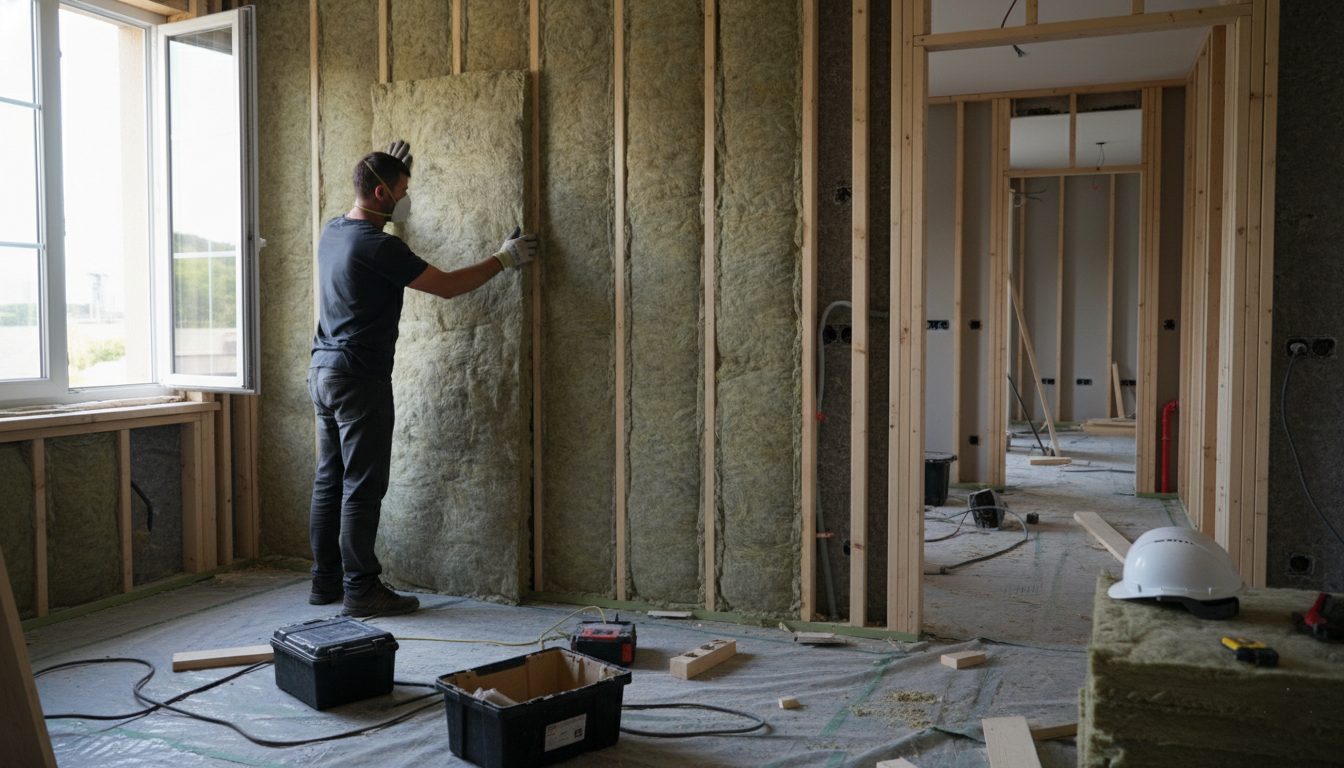
For hotel owners and managers undertaking permanent improvements, walls are the primary transmission path for airborne noise between guest rooms. The goal is to increase the wall's mass, density, and structural decoupling.
Mass-loaded vinyl (MLV)
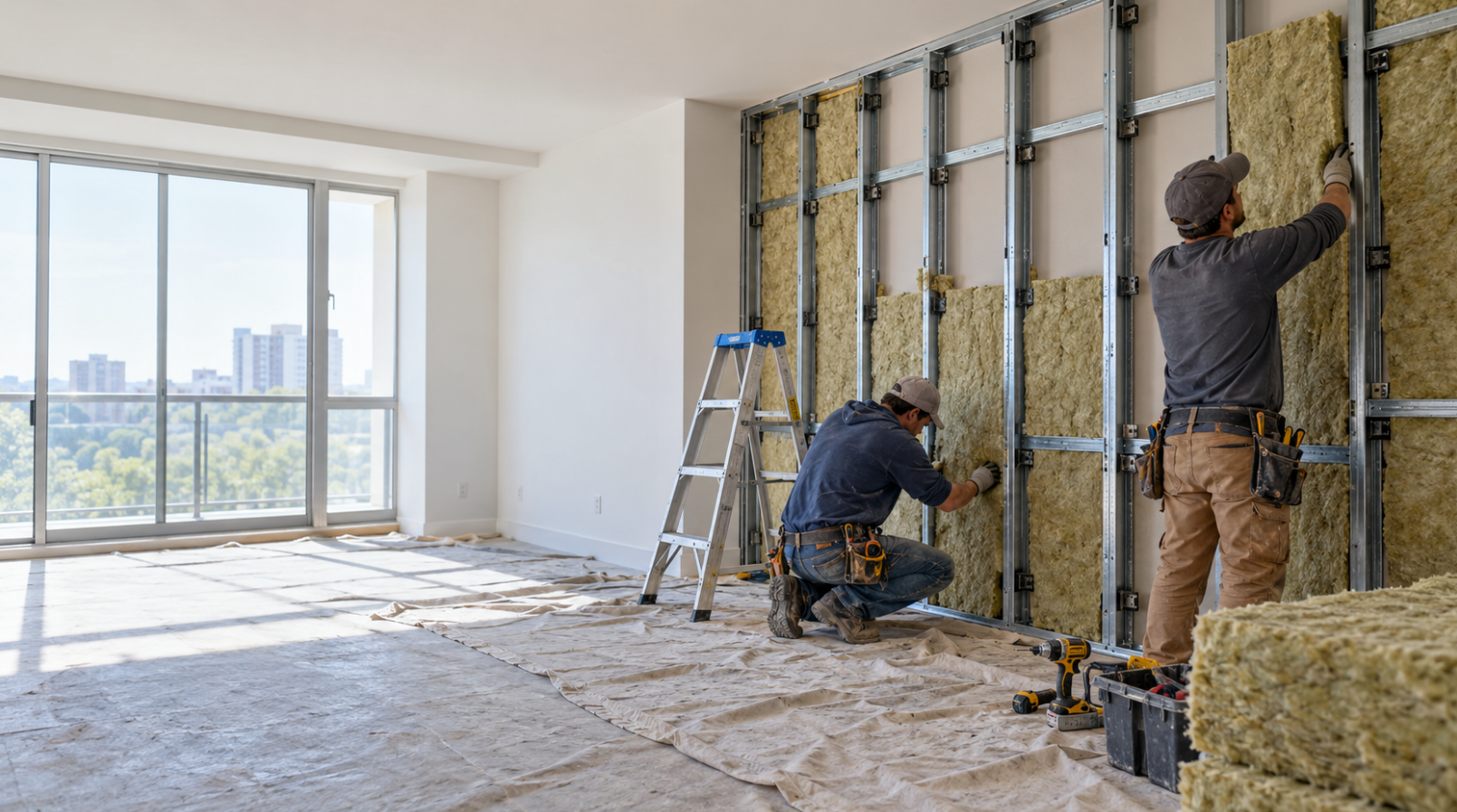
MLV is a dense, flexible barrier material applied directly to existing wall framing before a new layer of drywall is installed. A 1 lb/sq ft MLV layer adds approximately 3-4 STC points on its own. It performs best when combined with an air gap and acoustic absorption material such as mineral wool.
Double-layer gypsum drywall on resilient channels
Adding a second layer of 5/8" Type X gypsum board increases wall mass. Installing it on resilient channels - decoupled metal brackets - separates the new layer from the stud framing, breaking the vibration transmission path. This combination typically raises wall STC from 35-40 to 50-55.
Mineral wool insulation in wall cavities
Rockwool Safe'n'Sound or equivalent mineral wool products fill the stud cavity and absorb sound energy within the wall assembly. Mineral wool outperforms standard fiberglass for sound control due to its higher density - approximately 2.5-8 lb/ft³ vs. 0.5-1 lb/ft³ for fiberglass batts.
Suspended ceiling systems with acoustic infill
A suspended ceiling with mineral wool above is an effective ceiling soundproofing method that creates an air gap reducing both airborne noise and impact noise from the floor above. STC ratings in the 45-55 range are achievable with this approach.
Floating floor underlayment
Impact noise from the floor above is addressed by decoupling the finished floor surface from the structural slab. Resilient underlayment - rubber, cork, or foam isolation mat - beneath the floor finish reduces impact transmission. This is particularly effective in multi-story hotels where footfall noise from upper floors is a common guest complaint.
Soundproofing Hotel Doors and Windows
Doors and windows are the weakest acoustic points in a hotel room. A wall with STC 55 underperforms significantly if the door rates STC 25 and the window rates STC 28.
Solid-core doors vs. hollow-core doors
A standard hollow-core door achieves STC 20-25 - roughly equivalent to a single sheet of drywall. A solid-core door filled with particleboard or a composite material achieves an STC rating of 28-34. An acoustically rated door with proper perimeter seals reaches STC 40-50. Replacing hollow-core doors is one of the highest-return investments for reducing noise in hotels.
Door gaskets and automatic door sweeps
Perimeter door seals address the gaps at the top, sides, and bottom of the door frame. Magnetic gaskets seal the frame contact lines. An automatic door sweep closes the bottom gap when the door shuts and retracts when it opens, preventing floor wear. Together, gaskets and a sweep can add 8-12 STC points to an existing solid-core door by eliminating the flanking path through the perimeter gap.
Double-pane and triple-pane windows
Single-pane windows typically achieve STC 26-28. Standard residential double-pane IGU units reach STC 28-32. Laminated glass double-pane units with mismatched glass thicknesses achieve STC 36-42, because the thickness difference disrupts the resonance frequency that degrades standard double-pane performance at specific frequencies.
Window inserts (secondary glazing)
Window inserts are clear acrylic or glass panels installed inside the existing window frame, creating an additional sealed air gap without replacing the original window. They deliver STC improvements of 12-15 points over the base window. This is a cost-effective option for buildings where full window replacement is restricted or cost-prohibitive.
Acoustic sealant around window frames
Gaps between the window frame and the rough opening are a significant flanking path for noise. Low-VOC acoustic sealant - such as Green Glue Sealant or OSI SC-175 - applied to the perimeter of the frame seals these gaps permanently and adds negligible cost to any window upgrade project.
How Much Noise Reduction Can You Realistically Expect?
STC measures how much a building assembly reduces airborne sound. Each STC point represents approximately 1 dB of reduction; a 10 dB reduction is perceived as roughly half as loud by the human ear.
|
Method |
STC Improvement |
What It Means in Practice |
|
Foam earplugs (NRR 33) |
25-33 dB personal attenuation |
Voices become very faint; effective for sleeping |
|
White noise machine |
No dB reduction; masks the signal |
Reduces perceived annoyance of intermittent sounds |
|
Door bottom seal + gaskets |
+8-12 to door assembly |
Corridor speech becomes difficult to understand |
|
Window insert (secondary glazing) |
+12-15 over base window |
Street noise significantly reduced |
|
Hollow-core → solid-core door replacement |
+8-12 STC |
Corridor noise drops from audible to faint |
|
MLV + resilient channel + double drywall |
+15-20 to wall assembly |
The speech in the adjacent room becomes inaudible |
|
Double-pane laminated window |
STC 36-42 total |
Most traffic noise blocked; only low-frequency hum remains |
The distinction between sound blocking and sound absorption is critical. Acoustic panels and heavy curtains absorb reflections inside the room and reduce reverberation time, but they do not prevent sound from entering through walls, doors, or windows. Adding panels improves speech clarity inside the room - it does not reduce noise from adjacent rooms or the corridor.
No method achieves complete silence. A realistic target for hotel room renovation is a composite STC of 50-55, at which level a loud voice from an adjacent room is barely audible and normal conversation is inaudible.
Choosing the Right Approach for Your Situation

The right soundproofing method depends on whether you are a guest seeking immediate relief or a hotel owner planning structural upgrades.
Hotel guests dealing with immediate noise have the strongest options in the portable category: white noise masking, earplugs, door draft stoppers, and a room change request. These require no tools and directly address the most common complaint - corridor noise and adjacent-room sound.
Hotel owners seeking permanent improvement should prioritize in this order: door replacement and sealing (highest return per dollar), window upgrades or inserts, and then wall mass-loading with resilient channel decoupling. Addressing doors and windows first is sound practice because they are the weakest acoustic links and the most cost-effective to upgrade compared with full wall reconstruction.
The distinction between absorption and blocking defines whether a solution reduces noise entry or only reduces echo. Effective noise reduction always involves mass and seals - not surface treatment alone.