
Soundproofing a metal building requires a different approach than soundproofing wood-frame construction. Metal panels transmit sound easily, resonate at low frequencies, and create severe echo inside large open volumes. This guide covers each step in the correct sequence - from treating the building envelope to controlling interior reverberation - with specific materials and expected results for each stage.
Why Metal Buildings Are Difficult to Soundproof
An untreated metal building wall panel has an STC rating of 20-26, which means normal speech is clearly audible through it and loud noise passes through with minimal reduction. For comparison, a standard wood-frame wall with drywall on both sides achieves STC 33-36 without any insulation.
The low STC of metal panels has two causes. First, metal panels are thin and lightweight - they lack the mass needed to block airborne sound. Second, metal is rigid and highly conductive to vibration, which means it resonates like a drum membrane when struck by sound waves, rain, or mechanical vibration. This resonance amplifies certain frequencies rather than blocking them.
Inside a metal building, the problem compounds. Bare metal surfaces reflect nearly all sound energy back into the space. A metal warehouse or shop with no acoustic treatment typically has a reverberation time (RT60) of 4-8 seconds - meaning a single clap or spoken word echoes for up to 8 seconds before fading. This makes the interior uncomfortably loud, even from noise generated inside the building.
Effective soundproofing of a metal building must address three separate problems: transmission through the envelope (walls and roof), flanking through gaps and penetrations, and reverberation inside the space. Each requires a different method, and they must be addressed in sequence. If you need to quantify the current noise levels before planning treatment, sound measurements can establish baseline STC and RT60 values for your specific building.
Step 1 - Insulate the Metal Walls and Roof (Mass + Damping)
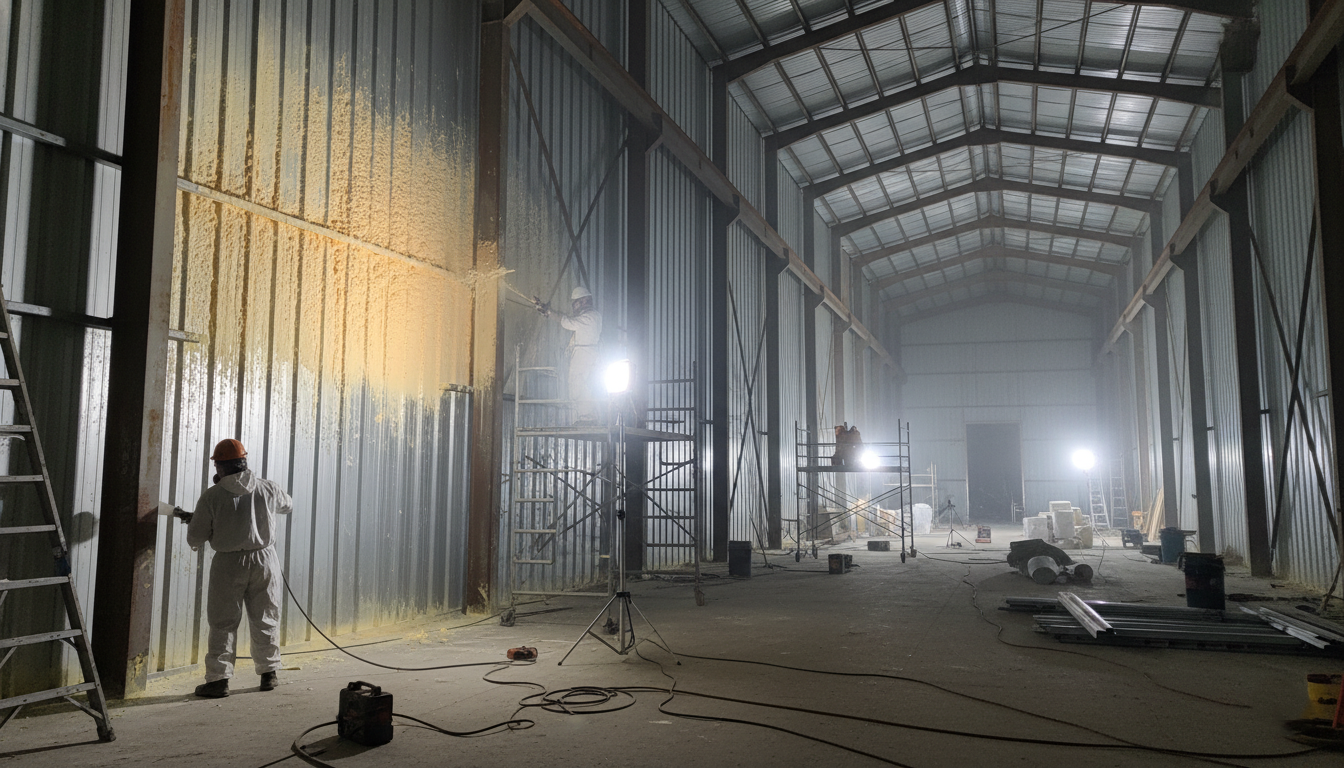
The first step in soundproofing a metal building is applying insulation directly to the interior face of the metal panels. This step simultaneously adds mass to the assembly and damps the resonant vibration of the metal - the two primary acoustic weaknesses of bare metal construction.
Open-cell spray foam is the most effective material for this application. Applied at 3-4 inches thickness directly onto the metal panels, open-cell spray foam adheres to the metal surface, fills all gaps and seams between panels, and converts vibration energy into heat through its viscoelastic structure. The result is a 10-15 STC point improvement over bare metal, plus near-complete elimination of rain and hail noise.
Rigid board insulation (polyisocyanurate or EPS foam board) is the alternative for applications where spray foam is impractical. Rigid boards must be mechanically fastened or adhered to the metal panels with no air gap between the board and the metal surface. An air gap allows the metal to continue resonating independently of the insulation layer, which reduces acoustic effectiveness.
Fiberglass batts cannot be applied directly to bare metal panels without a framing structure. Batts require a cavity to fill. If interior framing is being built (covered in Step 2), fiberglass or mineral wool batts in the cavity provide additional acoustic benefit, but they do not replace the need for direct contact treatment of the metal surface.
A spray foam application at 3.5 inches on a standard 26-gauge metal wall panel brings the assembly STC from approximately 22 to 34-38, depending on panel profile and application consistency.
Step 2 - Build a Decoupled Interior Wall Assembly
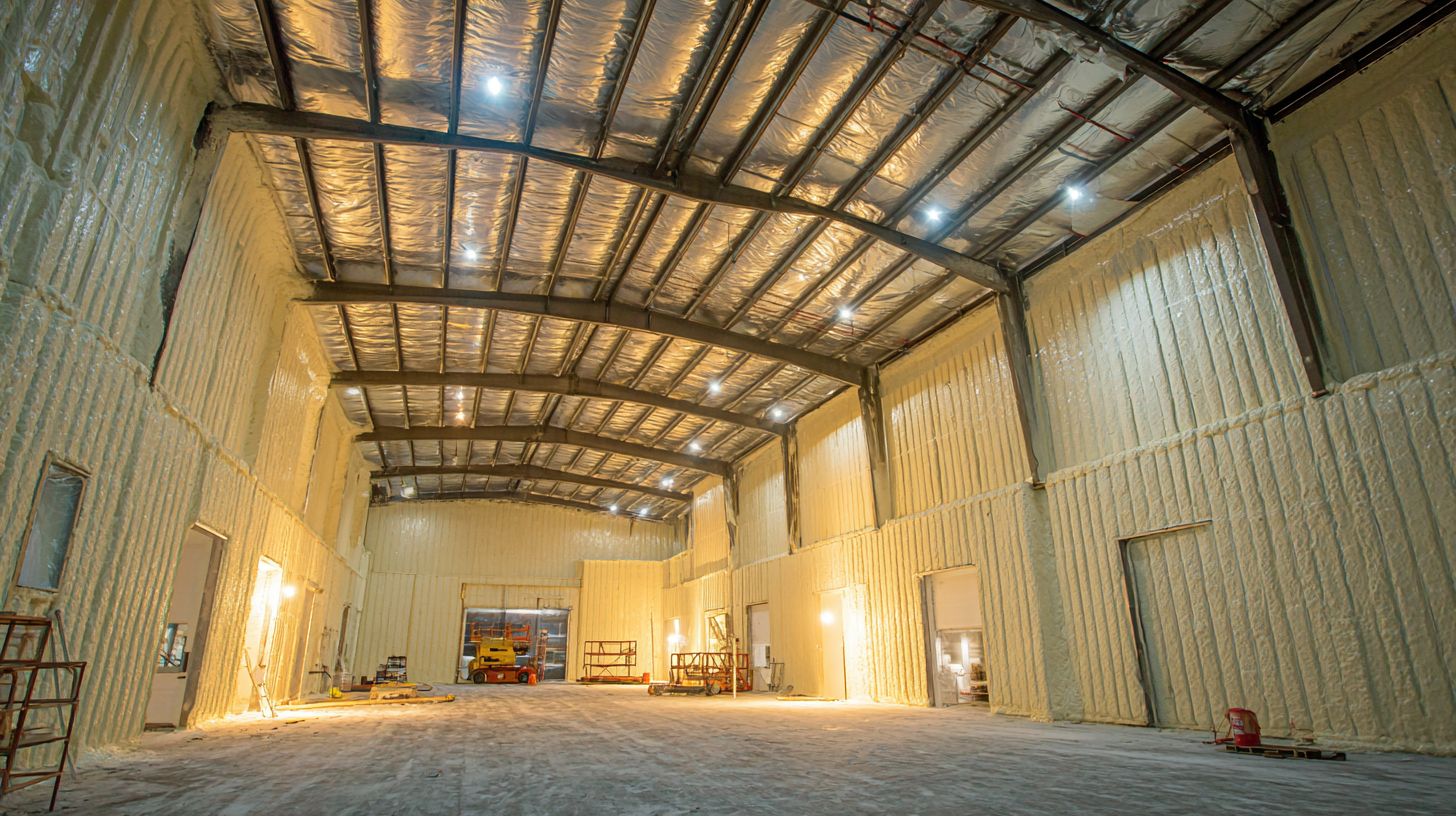
Spray foam or rigid board insulation on the metal envelope is sufficient for garages and light industrial applications where moderate noise reduction is acceptable. For barndominium living spaces, music rehearsal rooms, recording studios, or offices inside metal buildings, a decoupled interior wall assembly is required.
A decoupled interior wall is a standard stud-framed wall built inside the metal shell with a deliberate gap - typically 1-2 inches - between the metal panel and the new framing. The framing must not be bolted or anchored to the metal walls at any point except the floor and ceiling, and those connections should use isolation pads or resilient mounts to prevent vibration transfer.
The reason decoupling is necessary is flanking transmission. When a wall frame is attached directly to the metal structure, sound vibrations travel through the connection points and bypass the insulation entirely - a path called structural flanking. A gap between the metal shell and the interior frame eliminates the direct vibration path.
The recommended assembly for the interior wall cavity is mineral wool batts (STC contribution 45-52) combined with 5/8-inch drywall on the interior face. Adding a layer of Green Glue damping compound between two layers of drywall increases STC by an additional 5-8 points without increasing wall thickness significantly.
A complete assembly - spray foam on the metal + air gap + metal stud framing + mineral wool + double drywall with Green Glue - achieves a total wall STC of 52-58, which is sufficient for speech privacy and music rehearsal in most applications. For professional installation of the full interior wall system, see our wall soundproofing service.
Step 3 - Address the Roof and Rain Noise
Rain noise on a metal roof is a separate acoustic problem from wall transmission. A standard metal roof panel with no treatment produces impact noise levels of 85-95 dB inside the building during heavy rain - loud enough to interrupt speech and cause hearing fatigue over extended exposure.
The most effective treatment for metal roof noise is open-cell spray foam applied to the underside of the roof panels at a minimum thickness of 3 inches. The spray foam bonds to the metal, adds mass, and eliminates the air resonance chamber that amplifies rain impact. At 3-inch thickness, rain noise is reduced by approximately 20-25 dB, bringing interior levels during heavy rain down to 60-70 dB.
Rigid board insulation with a solid substrate directly behind the metal panels provides similar results to spray foam for rain noise, provided there is no air gap between the insulation and the metal surface.
Acoustic ceiling panels or hanging baffles below the roof structure address a different aspect of the same problem. They do not reduce how much noise enters through the roof, but they absorb and scatter the sound that does enter, reducing its reverberation and perceived loudness inside the space. For maximum rain noise control, the correct approach is spray foam on the roof panels plus acoustic treatment on the ceiling below.
Step 4 - Seal Doors, Windows, and Penetrations
Metal buildings accumulate acoustic flanking paths at every joint, seam, and penetration. Unsealed gaps around roll-up doors, sliding doors, HVAC penetrations, electrical conduit entries, and panel seams allow sound to bypass any insulation installed in the panels themselves.
Roll-up and sliding doors are the largest flanking path in most metal buildings. A standard roll-up door with no acoustic treatment has an STC of 12-18, far below any treated wall assembly in the same building. Options for roll-up doors include mass loaded vinyl curtains hung on the interior face (adds 8-12 STC points), acoustic blanket panels that cover the door opening, or replacement with an insulated commercial door for applications requiring maximum performance.
Panel seams and penetrations must be sealed with acoustical caulk or backer rod plus caulk at every location where two panels meet and around every pipe, conduit, or duct that passes through the wall or roof. A single 1/4-inch gap running the full height of a wall reduces the effective STC of the entire assembly by 10-15 points.
Windows in metal buildings are typically single-pane units set in metal frames with minimal sealing - STC 18-24. Acoustic window inserts fitted to the interior of existing window frames improve STC to 38-48 without replacing the original window. Our window soundproofing service covers both insert installation and full window replacement options.
Entry doors require acoustic door seals - continuous perimeter gaskets and an automatic door bottom seal - to eliminate the gap between the door and frame. A standard hollow-core door with gaps loses 15-20 STC points compared to the same door properly sealed. Full door treatment options are covered in our door soundproofing service.
Step 5 - Treat Interior Echo and Reverberation
Once the building envelope is treated, interior reverberation is the remaining acoustic problem in most metal buildings. A 2,000-square-foot metal shop with spray foam on walls and roof but no interior absorption will still have an RT60 of 2-4 seconds - acceptable for some industrial uses but problematic for offices, music rehearsal, or any space where speech intelligibility matters.
The target RT60 for different uses: speech intelligibility in offices and conference rooms requires RT60 below 0.6 seconds; music rehearsal spaces benefit from RT60 of 0.4-0.8 seconds; general workshops and industrial spaces are functional at 1.0-1.5 seconds.
Hanging acoustic baffles are the most practical treatment for large metal building interiors. Suspended from the roof structure in a grid pattern, baffles expose both faces to the room and provide double the sound absorption area per unit compared to wall-mounted panels. For a 2,000-square-foot space with a 16-foot ceiling, 400-600 square feet of baffle coverage typically reduces RT60 from 3-4 seconds to under 1 second.
Wall-mounted acoustic panels are effective in smaller metal building interiors - workshops under 800 square feet, rehearsal rooms, or recording booths built within a larger metal building. Panels should be distributed across multiple walls rather than concentrated on one surface.
Acoustic curtains are a flexible option for metal buildings where the space use changes - for example, a building that functions as a workshop during the day and a rehearsal space in the evening. Heavy acoustic curtains on ceiling-mounted tracks can be deployed when needed and retracted otherwise.
Soundproofing a Metal Building by Use Case
The correct combination of methods depends on the building's intended use. The following table summarizes the recommended approach by scenario:
|
Use Case |
Target STC |
Priority Steps |
Key Addition |
|
Garage / Light Workshop |
35-40 |
Steps 1, 4 |
Spray foam on walls + roof, seal roll-up door |
|
Commercial Warehouse |
38-45 |
Steps 1, 4, 5 |
Spray foam + baffles for echo control |
|
Home Workshop / Hobby Space |
42-48 |
Steps 1, 2, 4, 5 |
Interior framed walls + mineral wool |
|
Barndominium (Living Space) |
50-58 |
All 5 steps |
Full decoupled assembly + acoustic treatment |
|
Music Rehearsal / Band Practice |
52-60 |
All 5 steps |
Double drywall + Green Glue + ceiling baffles |
|
Recording Studio in Metal Building |
58-65+ |
All 5 steps + floating floor |
Room-within-a-room construction required |
Barndominium soundproofing requires all five steps in sequence. The combination of living quarters and metal structure creates both transmission and reverberation problems. Spray foam on the envelope plus decoupled interior walls with mineral wool typically brings STC to 52-56, sufficient for residential use. Roof spray foam is non-negotiable for rain noise.
Music rehearsal spaces in metal buildings require special attention to low-frequency bass. Bass frequencies below 200 Hz require mass and decoupling to control - spray foam alone does not provide adequate low-frequency isolation. A decoupled double-wall or double-stud assembly is required for drum rooms or bass-heavy rehearsal.
Recording studios inside metal buildings require room-within-a-room construction: a completely independent floating floor, decoupled walls with no structural connection to the metal shell, and a decoupled ceiling. This level of isolation is a construction project, not a materials application.
Putting It All Together
Soundproofing a metal building requires addressing the envelope, the gaps, and the interior in sequence. Spray foam or rigid board insulation applied directly to the metal panels eliminates resonance and adds mass. A decoupled interior wall with mineral wool and drywall brings STC to residential and commercial levels. Sealing roll-up doors, windows, and all penetrations eliminates flanking paths. Acoustic baffles or panels control interior reverberation.
The correct combination of steps depends on the building's use - a garage requires only Steps 1 and 4, while a barndominium or rehearsal space requires all five steps in full.