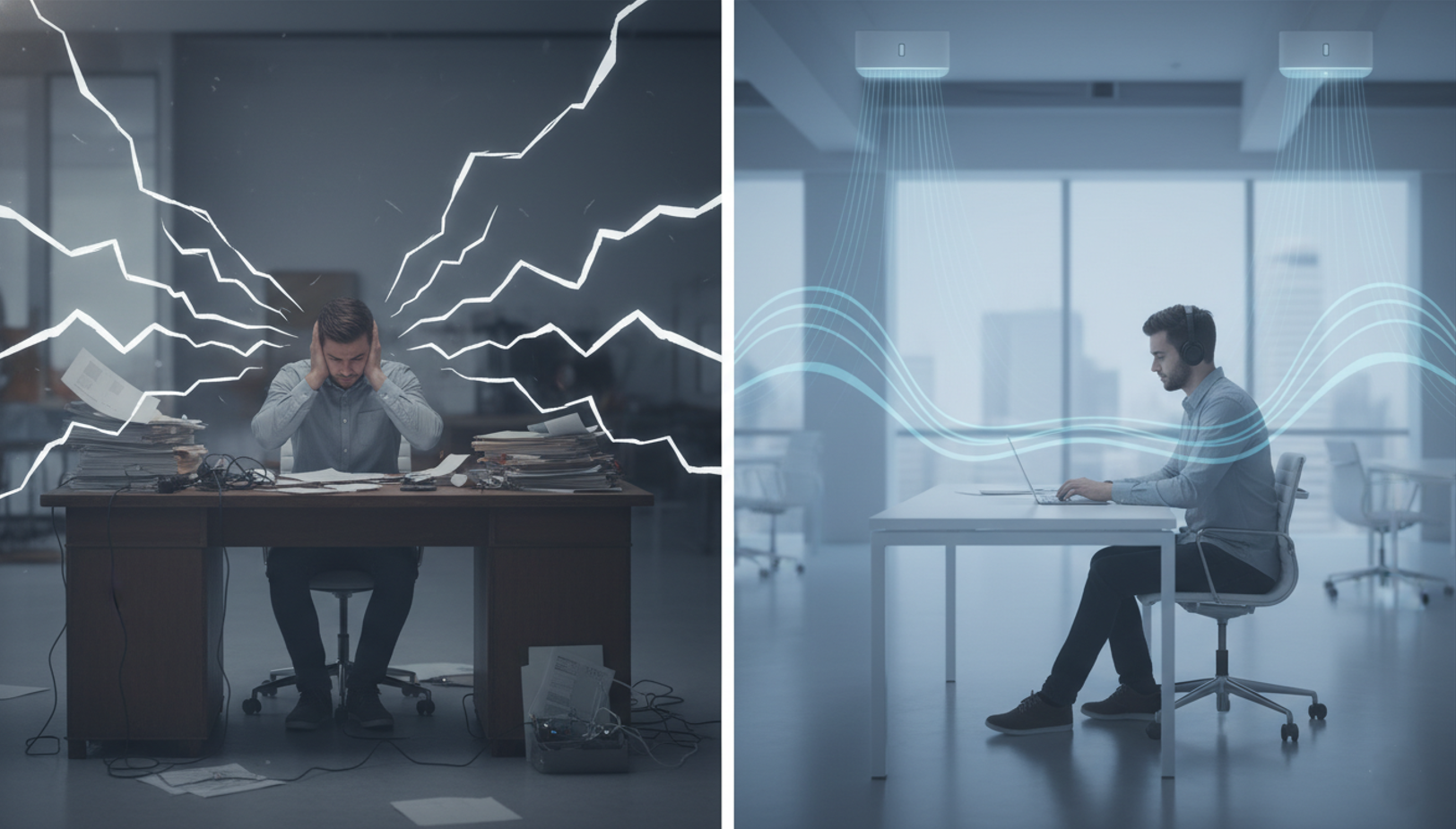
Sound masking is an engineered ambient sound calibrated to the frequency range of human speech. White noise is a static broadband signal that covers all audible frequencies at equal intensity, without targeting any specific range. Both are used to reduce noise distractions, but they work through fundamentally different mechanisms and are suited to different environments and use cases.
What Is White Noise?
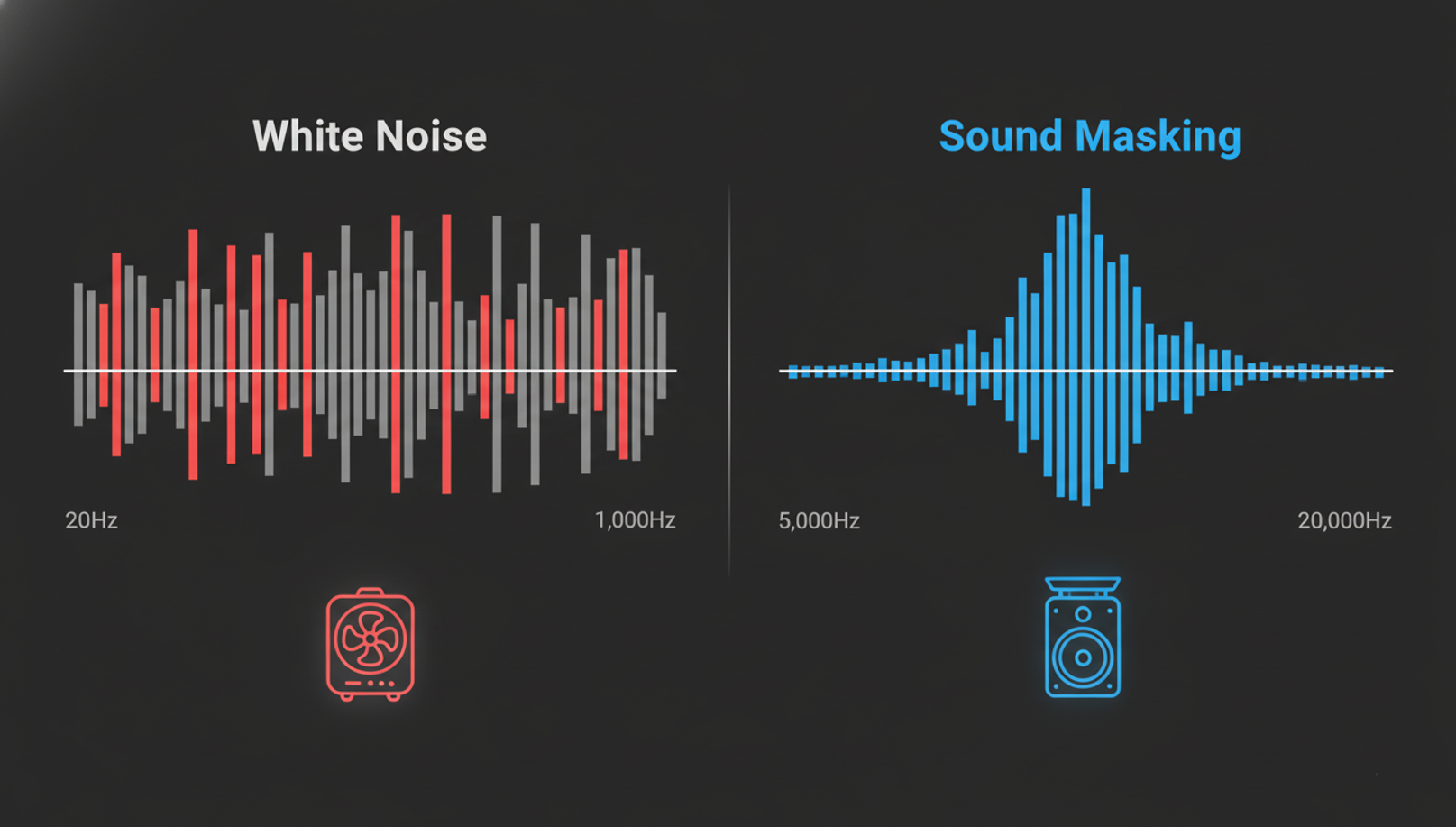
White noise is a broadband audio signal that distributes equal energy across all audible frequencies - from 20 Hz to 20,000 Hz. Its frequency profile is flat: no frequency range is emphasized or suppressed. The result is a sound comparable to untuned radio static, the continuous hiss of an air vent, or the hum of a box fan running at high speed.
White noise reduces the perception of unwanted sounds by raising the overall volume baseline of an environment. When the ambient noise floor increases uniformly, isolated sounds - a door closing, a nearby conversation - become less distinct against the background. This is a masking effect achieved through volume, not through frequency targeting.
The primary limitation of white noise is the relationship between effective volume and listener comfort. To mask speech reliably, white noise typically needs to reach 65-70 dB. At that level, the signal itself becomes a source of auditory fatigue. It does not blend into the background - it competes with it.
What Is Sound Masking?
Sound masking is an engineered ambient sound specifically designed to match the frequency range of human speech - approximately 1,000-5,000 Hz. Unlike white noise, it is not a uniform signal across all frequencies. Its spectrum is shaped to be acoustically comfortable while reducing the intelligibility of speech in a shared space.
A sound masking system works by introducing a low-level audio signal tuned to the speech frequency range. This signal reduces how clearly conversations can be heard and understood at a distance - a measurable parameter known as the radius of distraction. In a properly calibrated environment, conversations beyond 15-20 feet become unintelligible to listeners outside that radius.
To the human ear, sound masking resembles the soft, steady airflow of an HVAC system. It does not register as a distinct sound source. When calibrated correctly, occupants of a space are typically unaware it is present.
Sound masking operates effectively at 45-48 dB - a volume level that falls within the range of normal ambient background sound and does not cause auditory discomfort.
Sound Masking vs. White Noise - Key Differences
Sound masking and white noise differ across four critical dimensions: frequency profile, interaction with speech intelligibility, the volume required to be effective, and infrastructure scalability.
|
Parameter |
White Noise |
Sound Masking |
|
Frequency range |
Full spectrum (20-20,000 Hz) |
Targeted (1,000-5,000 Hz, speech range) |
|
Engineered for speech |
No |
Yes |
|
Effective operating volume |
~65-70 dB - becomes irritating |
~45-48 dB - blends into background |
|
Adaptive to environment |
No |
Yes - adjustable by zone |
|
Installation model |
Per-source generator |
Centralized ceiling-mounted system |
|
Typical use case |
Sleep, personal focus, home use |
Offices, clinics, open-plan commercial spaces |
The frequency curves of the two signals explain why their real-world performance differs so significantly. White noise produces a flat energy distribution across the full audible spectrum. Sound masking produces an elevated response specifically in the 1,000-5,000 Hz range - the band where human speech is most intelligible - while rolling off outside that range. This targeted profile is what allows sound masking to reduce speech intelligibility at low operating volumes.
To reliably mask a human voice, white noise must be amplified to approximately 65-70 dB. At that volume, the signal stops functioning as background and becomes a distinct, persistent noise source - one that competes with the very distractions it is intended to suppress.
A single sound masking generator, connected to a distributed ceiling speaker network, produces a uniform sound field across an entire floor or zone. Achieving equivalent spatial coverage with white noise would require a separate noise generator positioned near each individual source of unwanted sound - an approach that scales poorly and adds cumulative noise to the environment.
When White Noise Is Enough - and When It Isn't
White noise is a practical and sufficient solution for individual, personal-use scenarios. It works well for masking intermittent environmental sounds during sleep, maintaining focus at a single workstation, or reducing distractions in a small home office where only one person is present.
White noise is not engineered for shared or commercial spaces. Its limitations become pronounced in environments with multiple simultaneous noise sources, where the volume required for effective masking affects everyone in the space, regardless of their proximity to any individual source.
The following scenarios fall outside the effective range of white noise as a professional acoustic solution:
- Open-plan offices where multiple conversations occur simultaneously across a large area
- Conference rooms where speech privacy between adjacent spaces is required
- Medical reception areas where patient conversation confidentiality is a regulatory or ethical concern
- Legal and financial consultation environments where confidentiality applies to in-room speech
In any environment where the goal is speech privacy across a group of people - rather than personal focus for a single individual - white noise cannot achieve the required result without operating at a volume that creates its own acoustic problem.
When Sound Masking Is the Right Choice
Sound masking is the appropriate solution when the primary requirements are speech privacy, consistent acoustic comfort across a shared space, and scalable coverage of areas larger than a single workstation.
Let's consider the types of rooms that benefit directly from noise masking systems.
Open-plan offices
Sound masking reduces the radius of distraction, allowing employees separated by 15-20 feet or more to work without hearing intelligible speech from nearby colleagues.
Private offices with thin walls or glass partitions
Sound masking raises the ambient baseline in surrounding spaces, making it difficult to understand conversations occurring in the adjacent room.
Conference rooms
Sound masking applied to corridors and neighboring spaces prevents meeting content from being overheard outside the room.
Healthcare reception areas
Patient conversations at the front desk become unintelligible to others in the waiting area, supporting HIPAA-aligned acoustic privacy.
Legal and financial consultation offices
Confidential client discussions require that speech not carry beyond the designated meeting space.
Sound masking becomes technically necessary - rather than merely preferable - when a space exceeds approximately 200 square feet, contains multiple simultaneous conversation sources, or has specific speech privacy requirements.
In New York City, urban building environments present a specific acoustic challenge. High ambient noise from street traffic, HVAC systems, and neighboring tenants creates an uneven acoustic baseline that varies by floor, orientation, and time of day. A calibrated sound masking system normalizes that baseline uniformly across the entire occupied area, eliminating the acoustic inconsistencies that open-plan tenants in NYC buildings commonly experience.
How Sound Masking Is Installed and Calibrated
A sound masking system has three core components: a central signal generator, a network of loudspeakers installed above the ceiling grid or within the open plenum, and a zone controller used for calibration and adjustment. The generator produces the engineered signal; the speakers distribute it uniformly across the coverage area; the controller allows the system to be tuned independently by zone.
Calibration begins with a baseline acoustic measurement of the space. A technician records the existing ambient noise level, frequency distribution, and any acoustic irregularities caused by the room geometry or building materials. The masking signal is then adjusted to match the specific acoustic profile of that space - not a generic default output.
Zone-by-zone control allows the system to be tuned differently for areas with distinct acoustic requirements within the same building. A conference room, an open workspace, and a reception area may each require a different masking level and frequency emphasis.
New York Soundproofing provides on-site acoustic measurement and calibration as part of every sound masking installation in New York City and the surrounding metro area.
Which Solution Is Right for Your Space?

White noise covers the full audible frequency range equally and functions adequately for personal use at moderate volumes - primarily for sleep, individual focus, or intermittent background masking in a residential setting. Sound masking targets the speech frequency range specifically, operates at a volume that does not cause listener fatigue, and is designed for consistent, scalable deployment across commercial and professional spaces. For any environment where speech privacy, acoustic comfort, or reduced distraction across multiple workstations is the objective, sound masking is the technically appropriate solution. White noise is a general-purpose workaround; sound masking is an acoustically engineered system built for the specific problem of speech intelligibility in shared spaces.
New York Soundproofing installs and calibrates sound masking systems for offices, medical facilities, legal spaces, and commercial environments throughout New York City, Brooklyn, Manhattan, and the greater NYC metro area. Contact us for an on-site acoustic consultation.