
Floor Soundproofing
Floor soundproofing is the process of reducing noise that travels between vertically stacked spaces by adding mass, decoupling the structure, and installing resilient layers. It addresses two distinct problems: impact noise, such as footsteps and dropped objects, and airborne noise, such as voices and television from the room above or below.
These two types of noise are measured differently and respond to different treatments, which is why a single product rarely solves a floor noise problem on its own.

Reduce Impact and Airborne Noise Between Floors
Floor noise falls into two categories that require separate solutions: impact noise created by contact with the floor, and airborne noise created by sound in the air passing through the floor-ceiling assembly.
Impact noise is the most common complaint. Footsteps, dropped objects, moving furniture, and pets transmit vibration directly into the structure, which then radiates as sound into the space below.
Airborne noise is the second problem. Voices, music, and television generate sound waves in the air that pass through gaps and lightweight sections of the floor-ceiling assembly into the adjacent floor.
Treating one type does not automatically fix the other. A floor can be improved against footsteps yet still transmit voices, because impact and airborne noise travel through the assembly by different paths.
How Floor Soundproofing Works
Floors transmit two types of noise, each measured by a different rating, and understanding the difference is key to soundproofing a floor correctly. Impact noise is rated by Impact Insulation Class (IIC), and airborne noise is rated by Sound Transmission Class (STC), with higher numbers meaning better performance in each case.
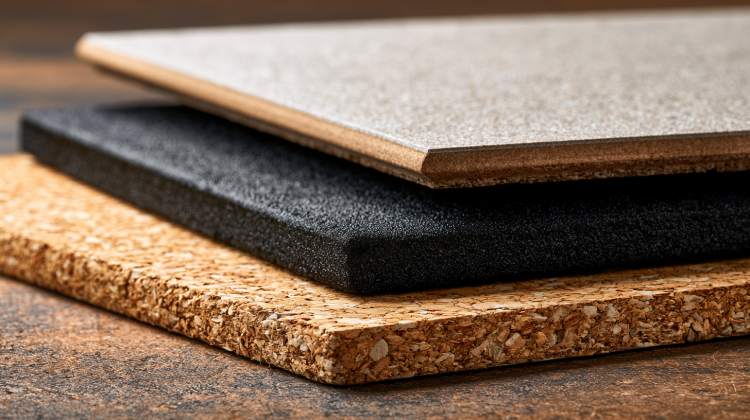
Reducing impact noise relies on resilient layers and decoupling. A soft, resilient underlayment or a floated floor separates the walking surface from the structure, absorbing vibration before it reaches the assembly below.
Reducing airborne noise relies on mass and sealing. Adding dense mass to the assembly and sealing gaps blocks the sound waves that would otherwise pass through lightweight sections of the floor-ceiling structure.
Acoustic underlayment, the product most retailers sell as "floor soundproofing," mainly improves impact noise under floating floors. It does relatively little for airborne noise and only modestly reduces serious impact noise, which is why underlayment alone often falls short.
A floor can also be treated from below. When the finished floor cannot be disturbed, soundproofing the ceiling of the room underneath by decoupling it and adding mass reduces both impact and airborne transmission into that space.

Our Floor Soundproofing Services
Our floor soundproofing services cover impact and airborne noise, and treat the assembly from above or below, depending on which surface can be accessed. Each service below targets a specific floor noise problem.
Acoustic Underlayment and Floating Floor Systems
Underlayment and floating floor systems reduce impact noise by placing a resilient layer between the finished floor and the structure. This raises the IIC of the assembly so footsteps and contact noise transmit less into the space below.
Floor Decoupling and Mass Buildup
Decoupling and mass buildup treat both impact and airborne noise from the top side. Adding a resilient mat with a dense mass layer separates the walking surface from the structure and blocks airborne sound that underlayment alone would let through.
Ceiling Soundproofing from Below
Ceiling soundproofing from below is used when the finished floor cannot be removed or altered. Decoupling the ceiling of the lower room with resilient channels or isolation clips and adding mass reduces both impact and airborne noise entering that space. (Internal link: dedicated Ceiling Soundproofing page.)
Impact Noise Control for Apartments and Condos
Impact noise control targets footstep noise between stacked units, the most common complaint in apartments and condos. The treatment combines resilient isolation and mass to meet building requirements and reduce noise transfer between neighbors.

Why Choose Our Floor Soundproofing Company
Effective floor soundproofing depends on correctly identifying whether the problem is impact noise, airborne noise, or both, and on choosing the right side of the assembly to treat.
Licensed Installers with Decades of Acoustic Experience
Our installers are licensed and have spent decades on soundproofing and acoustic projects across residential and commercial buildings. That experience covers floor-ceiling assemblies from both sides, so the solution is designed around correct acoustic principles rather than a single product.
The Right Method, Not Just Underlayment
We specify the treatment based on the measured noise type instead of defaulting to underlayment. This prevents the common mistake of installing a resilient underlayment for an airborne noise problem that it cannot solve.
In-House Manufactured Acoustic Materials
We manufacture acoustic materials in New York City and select each product to match the assembly and the noise type. This control lets us target IIC and STC performance to the specific floor, rather than forcing a single product on every job.
Solutions for Occupied Apartments and Buildings
We design floor soundproofing for occupied apartments, co-ops, and condos, including treatments applied from the ceiling below when the upper unit cannot be disturbed. This makes it possible to reduce noise between neighbors without gutting a finished floor.

Our Floor Soundproofing Process
Our process moves from measurement to a verified result in four stages, so the assembly is treated for its actual noise problem rather than based on a general assumption.
On-Site Assessment - Impact vs Airborne
We assess whether the problem is impact noise, airborne noise, or both, and inspect the floor-ceiling assembly. This establishes the baseline and identifies which side of the assembly to treat.
Assembly Design with IIC and STC Targets
We set IIC targets for impact noise and STC targets for airborne noise based on the assessment. Defining measurable targets ensures the assembly is treated to a standard rather than by guesswork.
Installation from Above or Below
We install the treatment on the accessible surface, either building up the floor from above or soundproofing the ceiling below. Gaps and flanking paths are sealed as part of the work.
Verification and Sound Measurement
We measure noise after installation and compare it to the baseline. This confirms the real-world reduction achieved rather than relying on a material's lab rating alone.

How Much Noise Reduction to Expect
Floor soundproofing produces measurable results, but the outcome depends on the noise type, the assembly, and which side is treated, not on the word "soundproof."
Impact noise reduction is governed by IIC and by decoupling. A resilient underlayment typically provides a modest impact improvement to a floating floor, whereas a fully decoupled floor or ceiling assembly delivers substantially more.
Airborne noise reduction is governed by STC and by mass and sealing. Underlayment adds little airborne performance on its own, so meaningful airborne reduction requires added mass and sealed gaps in the assembly.
Treating from below is limited by the existing structure. Decoupling the ceiling and adding mass reduces transmission into the lower room, but the achievable result depends on ceiling height, existing framing, and how the assembly is built.
Low-frequency impact noise is the hardest to control. Heavy footfalls and structural vibration carry low frequencies that require decoupling and mass rather than a thin resilient layer alone.
Schedule Your Floor Soundproofing Today
Floor soundproofing starts with an on-site assessment that separates impact noise from airborne noise and sets measurable IIC and STC targets. From there, we design, install, and verify a solution treated from the right side of the assembly.
📞 Call Now to book your assessment, or Request Your Free Quote to get a floor soundproofing plan for your space.
FREQUENTLY ASKED QUESTIONS
Will soundproofing a floor eliminate all noise?
No. Floor soundproofing reduces noise to a lower, less disruptive level rather than creating silence. Low-frequency impact and structural vibration are the hardest to remove, so the goal is a measurable, noticeable reduction.
What IIC or STC rating does a floor need?
Higher IIC and STC numbers mean better performance, and many multifamily buildings set minimum ratings for both. The right target depends on the building and the noise complaint, which is why an assessment defines specific IIC and STC goals before work begins.
How do you reduce footstep noise from an upstairs neighbor?
Footstep noise is impact noise and is best reduced by decoupling and resilient isolation. This can be done by building up the upstairs floor with a resilient layer and mass, or by soundproofing the ceiling below with isolation clips or resilient channels and added mass.
Can you soundproof a floor without removing the existing floor?
Yes. When the finished floor cannot be disturbed, the floor-ceiling assembly can be treated from below by decoupling the lower room's ceiling and adding mass. This reduces both impact and airborne noise entering that space.
Does acoustic underlayment soundproof a floor?
Underlayment primarily reduces impact noise under a floating floor and does little to reduce airborne noise. It helps with footsteps but is limited on its own, so serious floor soundproofing usually combines a resilient layer with added mass and sealing, or treats the ceiling below.
What is the difference between impact and airborne noise on a floor?
Impact noise is created by contact with the floor, such as footsteps and dropped objects, and is rated by IIC. Airborne noise is created by sound in the air, such as voices and television, and is rated by STC. Floors need different treatments for each, and reducing one does not automatically reduce the other.

New York's Soundproofing Experts
We specialize in creating highly-customized sound environments such as home offices, recording studios, home studios and music rooms, conference & teleconference rooms, bars and clubs, offices, restaurants, temples, churches, school auditoriums and much more.