
Restaurant Soundproofing
Soundproofing a restaurant is less about silence and more about control. Guests should be able to talk across the table without leaning in, staff should hear orders the first time, and the room should still feel lively. New York Soundproofing designs, builds, and installs acoustic treatment for restaurants, cafes, and dining rooms across New York City, and we schedule the work around your service hours so you don't lose a night of business.
We start every project by measuring the room. That tells us whether your noise problem is echo inside the dining room, sound coming through walls and windows, or both, and each of those needs a different fix.
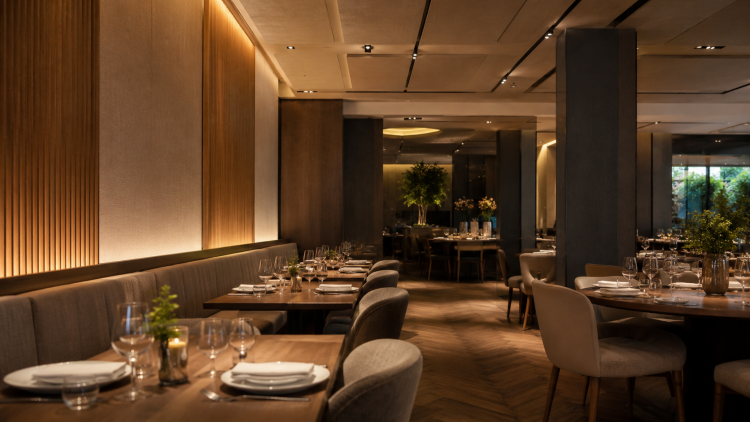
Why Restaurants Get So Loud
Most restaurant noise is created inside the dining room itself. Concrete floors, exposed ceilings, brick, glass, and tile look great, but they reflect almost every sound that hits them. Conversations, chair scrapes, and clattering plates bounce around the room, the background level climbs, and guests raise their voices to be heard, which only makes it louder.
Open kitchens and busy bars add their own layer, and background music gets turned up to compete with the crowd. In buildings where the main floor shares walls with private dining rooms, that noise travels too.
Street-facing restaurants also take in traffic and sidewalk noise through windows, doors, and storefront glass.
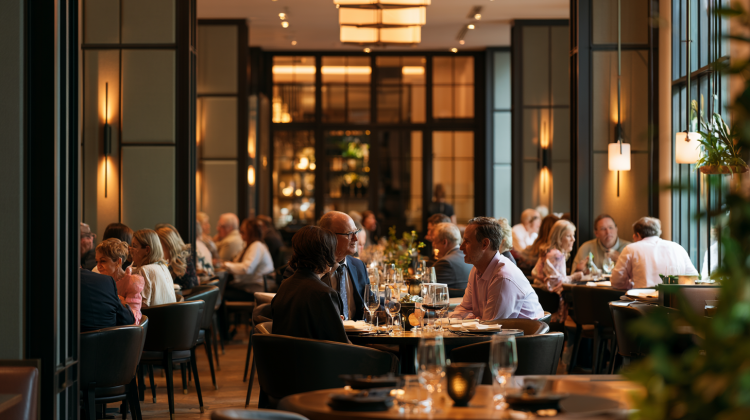
Sound Absorption vs Soundproofing in Restaurants - How It Works
Restaurant owners often use "soundproofing" for any noise fix, but there are two different problems with two different solutions. Getting this right is the difference between money well spent and panels that change nothing.
Sound absorption reduces echo inside a room. Soft, porous materials such as fabric-wrapped panels and ceiling clouds soak up sound energy instead of reflecting it. Absorption is rated with the Noise Reduction Coefficient (NRC), on a scale from 0 to 1, where higher numbers mean more sound absorbed.
Soundproofing blocks sound from passing between spaces, such as from the kitchen into the dining room, or from your restaurant into the apartment upstairs. It relies on mass, airtight seals, and solid construction. Blocking performance is rated with Sound Transmission Class (STC), where a higher number means less sound gets through.
In most restaurants, absorption solves the biggest problem, because the noise guests complain about is generated in the dining room itself. Blocking becomes the priority when sound travels to neighbors, between separate rooms, or in from the street. Cheap acoustic foam rarely helps with either: it absorbs only higher frequencies and doesn't block sound at all.
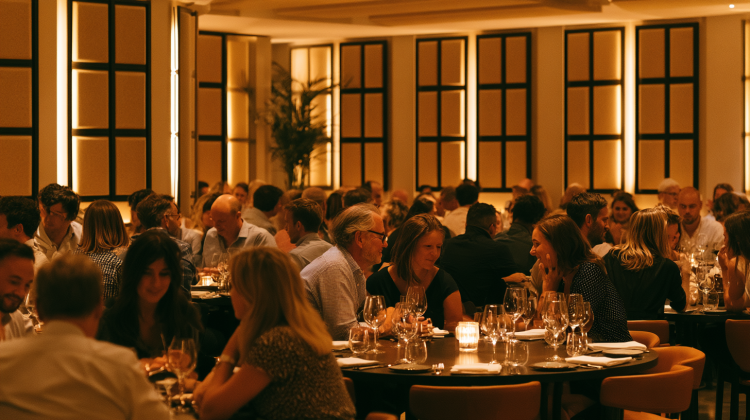
Our Restaurant Soundproofing Services
We match each treatment to the problem it actually solves. Here is what we install in restaurants, cafes, and dining rooms.
Dining Room Acoustic Treatment
The main dining room is where most restaurant sound dampening happens. We add enough absorptive surface area to bring reverberation down, so conversations stay at their own table instead of spreading across the room.
Acoustic Panels for Restaurants
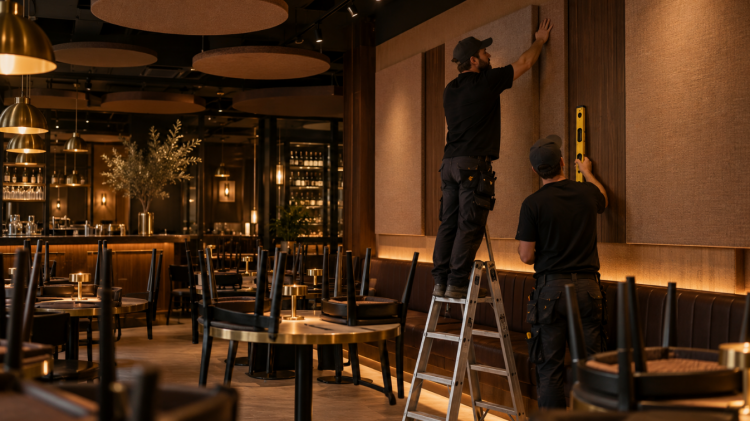
Acoustic panels for restaurants absorb sound while working as part of the interior. We make fabric-wrapped panels in custom sizes and colors, printed panels that carry artwork, photography, or branding, and wood slat panels for a warmer, architectural look. For larger areas, acoustic upholstery covers entire walls or ceilings in fabric over an absorptive layer. Panels are built in our New York shop to fit your space exactly.
Ceiling Clouds and Baffles
The ceiling is often the largest untreated surface in a restaurant, especially with exposed or high ceilings. Suspended acoustic ceiling clouds and panels and hanging baffles add absorption overhead without taking up wall space you need for décor.
Kitchen and Bar Noise Isolation
When noise comes from an open kitchen or bar, we focus on stopping it at the source and along its path. That can include soundproof doors, added mass in partition walls, and absorptive treatment near the noisiest equipment. For bars and lounges as standalone venues, see our bar and lounge soundproofing service.
Private Dining Rooms and Partitions
Private rooms and event spaces need separation from the main floor. Acoustic partitions, curtains, and sealed doors help create distinct zones, so a large party doesn't take over the whole restaurant.
Street Noise Reduction
For street-facing dining rooms, we treat the openings where outside noise gets in. Window soundproofing and door soundproofing cut traffic and sidewalk noise without changing the look of your storefront.
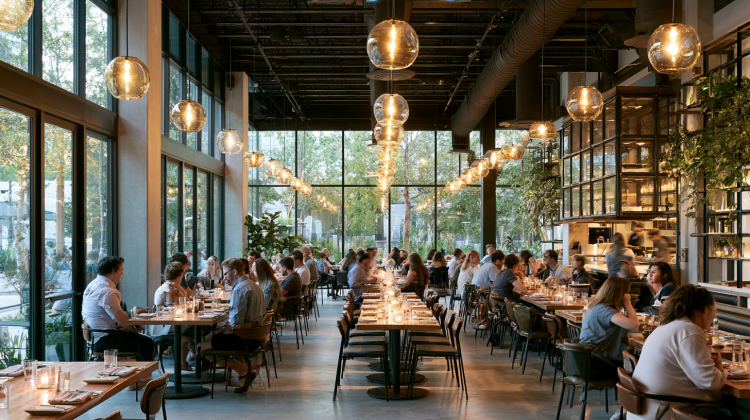
Where Restaurant Noise Needs Treatment
Every area of a restaurant has its own acoustic job. This table shows what we typically focus on in each one.
|
Area |
Main problem |
Typical treatment |
|
Main dining room |
Echo and crowd noise build-up |
Wall panels, ceiling clouds, acoustic upholstery |
|
Bar |
Loud conversation and music spilling into dining |
Ceiling absorption, panels near the bar, partitions |
|
Private dining rooms |
Noise from the main floor coming in |
Sealed doors, partitions, acoustic curtains |
|
Open kitchen |
Equipment and staff noise |
Absorption near the pass, isolation where possible |
|
Entrance and waiting area |
Street noise and crowding at the door |
Door seals, wall panels |
|
Outdoor patio |
Traffic noise and sound reaching neighbors |
Outdoor soundproofing barriers and panels |
Our Restaurant Soundproofing Process
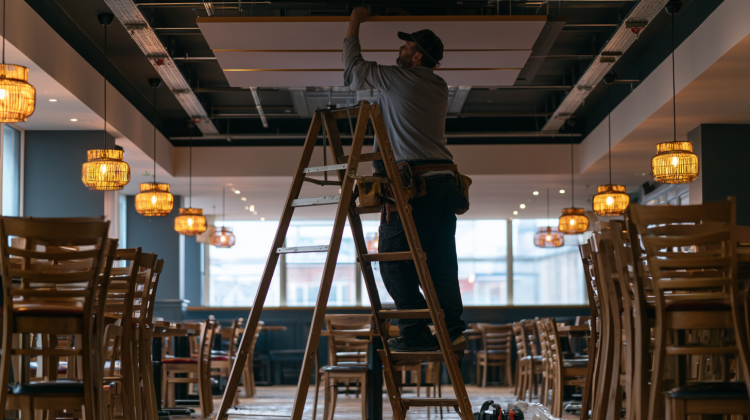
Each project follows four steps, planned so your restaurant stays open.
On-Site Noise and Reverberation Assessment
We measure baseline noise levels and reverberation during or close to real service conditions. This separates echo problems from transmission problems before anything is specified.
Treatment Design with NRC and STC Targets
Based on the measurements, we set clear targets for absorption and blocking and design treatment that fits your interior, from panel placement to fabric colors.
Installation Around Your Service Hours
We install overnight, early in the day, or between services, so you don't have to close for the work.
Verification and Sound Measurement
After installation, we measure again and compare the results with the baseline, so you can see how much the room has changed.
How Much Noise Reduction to Expect
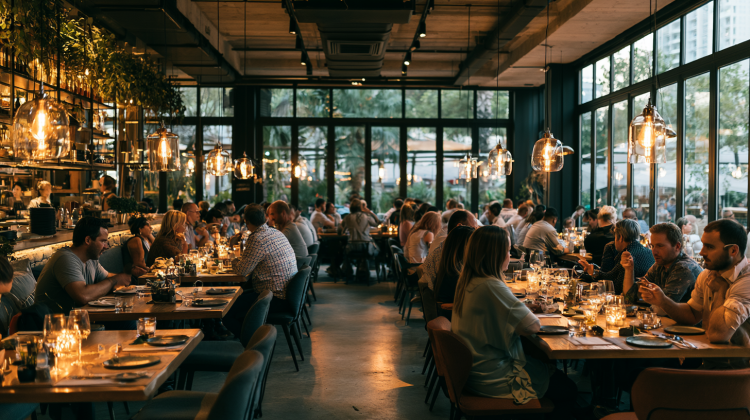
Results depend on how much absorption the room gains, which transmission paths are treated, and how hard the existing surfaces are. A comfortable conversation sits at roughly 60 to 70 dB, while a busy dining room full of hard surfaces can reach 80 to 100 dB or more. Well-placed absorption brings a reverberant room noticeably closer to the comfortable range, and guests usually notice the difference on the first busy night.
Low-frequency sound, such as bass from a sound system or rumble from mechanical equipment, is the hardest to control. If your issue is bass reaching neighbors, expect the solution to involve construction work, not just panels.
Neighbor Complaints and Noise from Music
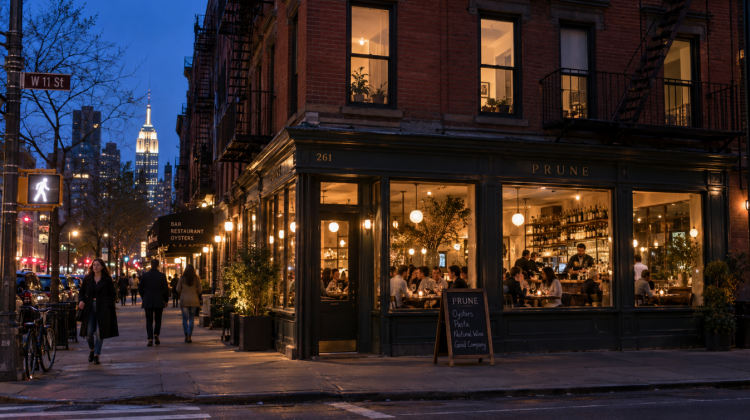
Restaurants in mixed-use buildings often share walls and ceilings with apartments and offices. Music and late-night crowds are the usual triggers for complaints, and New York City's Noise Control Code regulates sound from commercial establishments. We measure how much sound reaches the neighboring space, find the paths it takes, and design isolation that reduces it, so you can keep the atmosphere you want with fewer complaints.
Why Choose Our Restaurant Soundproofing Company
Restaurants hire us because we understand both acoustics and how a dining room actually runs. Here's what that means in practice.
Licensed Installers with Decades of Acoustic Experience
Our licensed team has worked on acoustic projects for decades, in restaurants, bars, offices, and public spaces across the city.
Absorption and Blocking Diagnosed Correctly
We identify whether you have an echo problem, a transmission problem, or both before recommending anything, so you don't pay for treatment that misses the cause.
Design-Integrated Acoustic Treatment
Panels, clouds, and upholstery are made to match your décor. Many guests never realize the room has been treated, only that it's easier to talk.
In-House Manufacturing in NYC
We build panels in our own New York shop, which gives us control over sizes, fabrics, colors, and lead times.
Installation Around Your Service Hours
We work overnight or between services, so treatment goes in without closing your doors.

Get a Free Restaurant Acoustic Assessment
If your dining room is too loud for comfortable conversation, an on-site assessment will show where the noise comes from and what it will take to fix it. Call us at (877) 999-2201 or fill out the form below to request a free quote.
FREQUENTLY ASKED QUESTIONS
Can acoustic panels match my restaurant's interior?
Yes. Panels can be made in custom sizes, wrapped in fabric that matches your color palette, printed with artwork or branding, or built as wood slat panels that blend into the design.
Can a restaurant be soundproofed while it stays open?
Yes. Absorptive panels, ceiling clouds, and most blocking treatments can be installed overnight or between services. Scheduling the work around service hours keeps the restaurant operating during the project.
How do you reduce noise from an open kitchen or bar?
Open kitchen and bar noise is a transmission problem addressed by blocking. Soundproof doors, added mass, and wall treatment raise the STC between the noisy area and the dining room, reducing the amount of that noise reaching guests.
How do you quiet a dining room without a full renovation?
Reverberation can be reduced by adding absorptive panels, ceiling clouds, and baffles that mount to existing walls and ceilings. These add absorptive area without structural work and are the most common non-renovation fix for a loud dining room.
Why are restaurants so loud?
Restaurants are loud because hard surfaces reflect sound instead of absorbing it. Concrete floors, exposed ceilings, glass, tile, and minimal soft furnishings cause voices and clatter to build up, and as the room gets louder, guests raise their voices, pushing the level higher.
What is the difference between sound absorption and soundproofing in a restaurant?
Absorption reduces echo and reverberation inside the dining room and is measured by NRC. Soundproofing blocks noise from passing between spaces and is measured by the STC rating. Most restaurant noise is reverberation, so absorption is usually the primary treatment.
Does soundproofing a restaurant actually work?
Yes. Adding absorption reduces reverberation and lowers the overall noise level, while blocking keeps kitchen, bar, and street noise out of the dining room. The goal is to bring a loud room down to a comfortable conversation level of about 60 to 70 dB, not to make it silent.

New York's Soundproofing Experts
We specialize in creating highly-customized sound environments such as home offices, recording studios, home studios and music rooms, conference & teleconference rooms, bars and clubs, offices, restaurants, temples, churches, school auditoriums and much more.