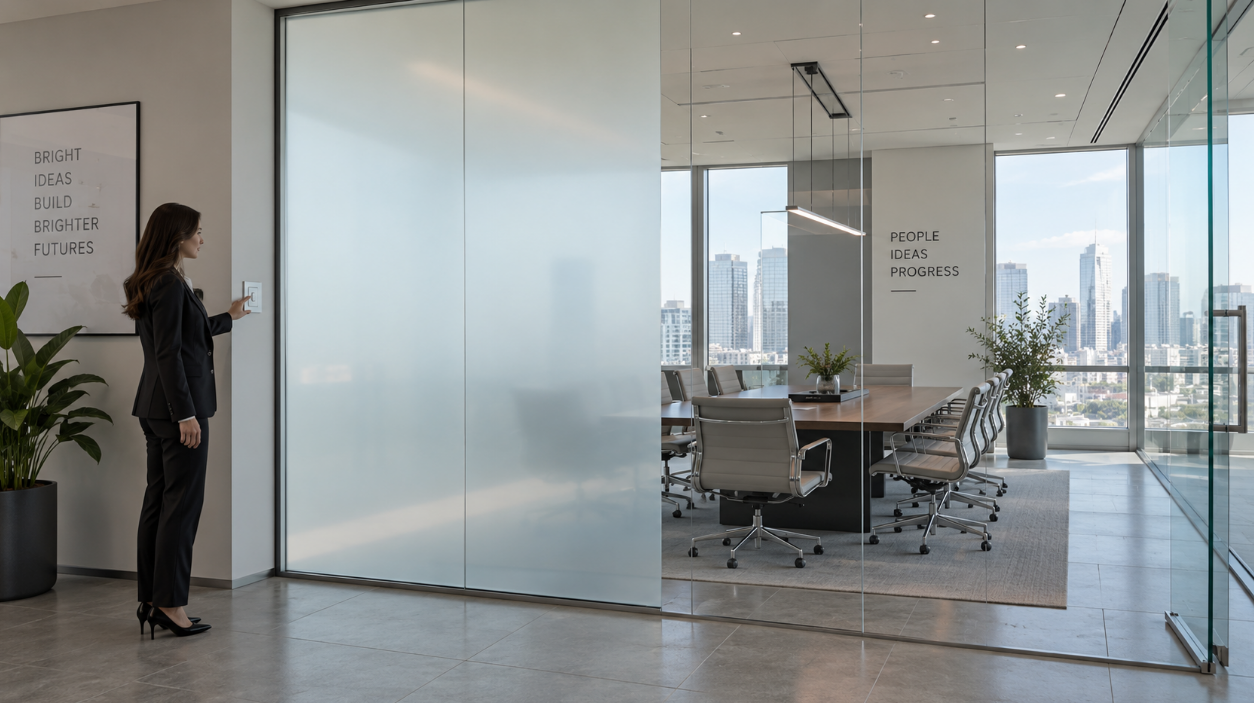
Smart film works by running a low electrical voltage through a layer of liquid crystals sealed inside the film. With power on, the crystals align and let light pass straight through — the film turns clear. With power off, the crystals scatter randomly, light diffuses in every direction, and the film turns opaque white. The switch happens in a fraction of a second, and the whole system runs on less electricity than a light bulb. Here's how the technology behind it actually works, layer by layer.
What Is Smart Film
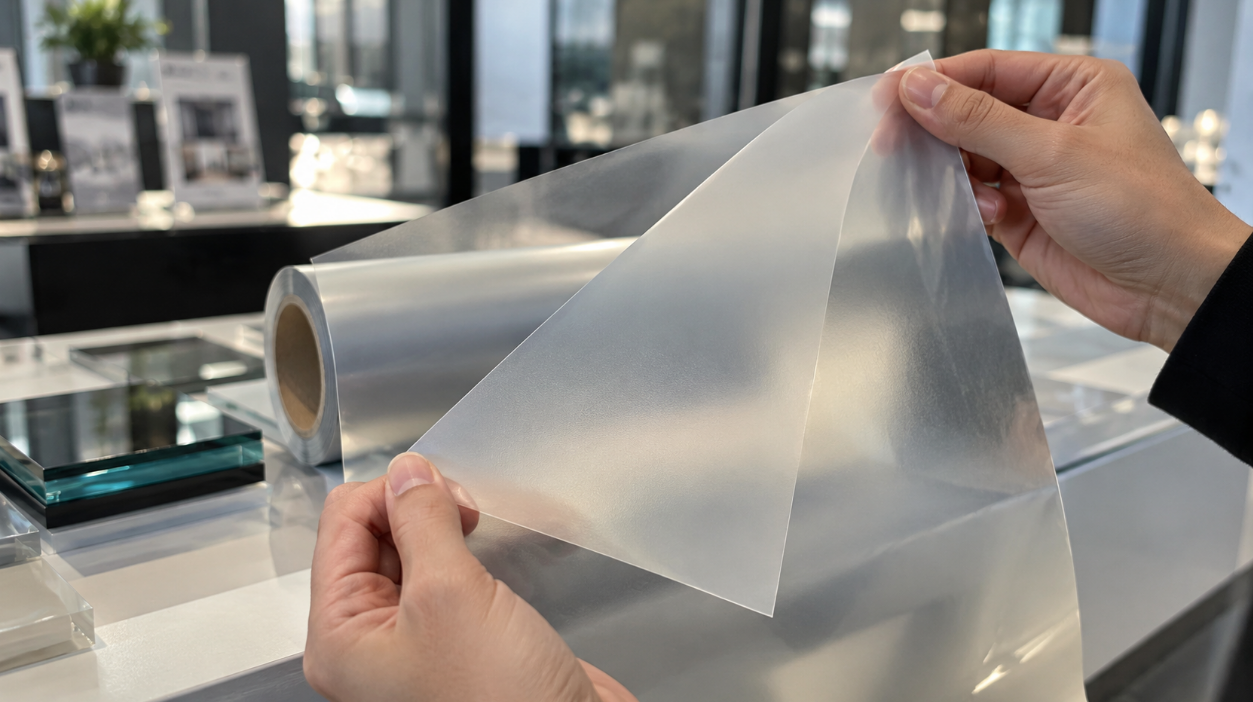
Smart film is a thin, self-adhesive PDLC film that switches between opaque and transparent when voltage is applied. PDLC stands for Polymer Dispersed Liquid Crystal: microscopic droplets of liquid crystal suspended in a polymer layer, sandwiched between two conductive transparent sheets. The film sticks to existing glass, which is what makes it a retrofit product — you get switchable privacy without replacing a single pane.
The same technology travels under many names: switchable film, privacy film, electric film, smart tint. If you've been wondering how does smart tint work as opposed to smart film — it's the same question with the same answer. All of these are PDLC products, and the branding differs more than the physics.
What separates smart film from ordinary window tint is that tint is static — it darkens the glass permanently — while smart film changes state on command. Professional smart film installation turns a regular office partition, storefront, or bathroom window into privacy glass controlled by a switch, remote, or smart home system.
How Smart Film Works - The Two States
The principle in one sentence: liquid crystals align under an electric field and pass light; without the field, they scatter it.
In the off state, the liquid crystal droplets inside the polymer layer orient randomly. Incoming light hits millions of these disordered droplets and scatters in every direction instead of passing through. Your eye reads that scattered light as a milky, frosted white surface. Shapes and shadows may be faintly visible up close, but detail is gone — that's the privacy state.
In the on state, an alternating current creates an electric field across the film. The field forces the liquid crystal molecules to line up in the same direction, creating a straight path for light. Light passes through with minimal scattering, and the film reads as clear glass. Quality films reach 82–92% visible light transmission in the clear state — close enough to plain glass that most people can't tell the film is there.
The transition between states takes milliseconds — well under a second in both directions. There's no fade-in or warm-up; the film flips essentially instantly.
One design consequence worth knowing: smart film is "power-off opaque." If the electricity is cut, the film defaults to its frosted privacy state, not to clear. For most applications — bathrooms, conference rooms, medical suites — that's the failure mode you'd want.
What's Inside? The Layers of Smart Film
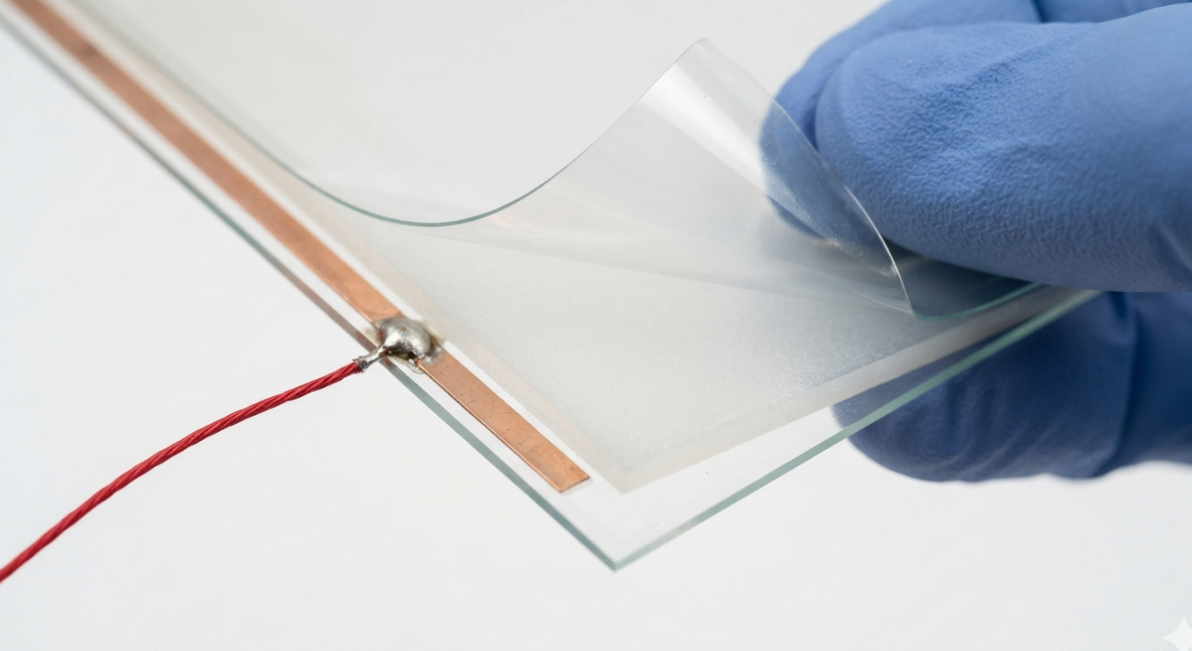
Smart film is a five-layer sandwich, and the whole stack is thinner than a millimeter — around 0.4 mm in total. Each layer has one job, and together they turn a sheet of plastic into a switchable surface.
Adhesive Layer
The bottom of the stack is the adhesive layer with a peel-away protective liner. This is what bonds the film to existing glass — the liner comes off during installation, and the exposed adhesive side is smoothed onto the pane.
ITO-Coated PET Sheets
Above the adhesive sit two clear polyester (PET) sheets, each coated with Indium Tin Oxide — a transparent conductor. These are the film's electrodes. One sheet sits below the crystal layer and one above it, and together they deliver current across the entire surface. Because ITO spreads the charge evenly, the whole film switches at once rather than in patches.
The ITO coating is also the film's most delicate component. Physical damage to it is the most common cause of dead zones or failure, which is why edges and wiring points need careful handling during installation.
PDLC Layer
Between the two conductive sheets lies the working core: liquid crystal droplets dispersed in a polymer matrix. This is where the switching happens — the crystals align when the electrodes create a field and scatter when they don't. Everything else in the stack exists to protect this layer and feed it power.
Protective Outer Layer
The top of the sandwich is a protective coating that shields the stack from scratches and moisture. It's the layer you actually touch when the film is installed.
How Power Gets In
Electricity enters the film through busbars: thin copper conductive strips attached along the film's edge. The busbars connect by wire to a transformer, and from there to a wall switch, remote receiver, or building automation system. From the busbars, the ITO sheets carry the charge across every square inch of the film.
Power, Voltage, and Energy Use
Smart film runs on low-voltage alternating current supplied through a transformer. Most PDLC systems operate at 48–65V AC: the transformer steps standard building voltage down to that range and typically hides in the ceiling or a nearby closet. The current type matters — PDLC film requires AC, and connecting it to direct current damages the liquid crystals and causes premature failure. This is one of several reasons the electrical side of the job belongs to an electrician even when the film itself is a simple application.
Consumption is minimal. The film draws roughly 3–5 watts per square meter in the clear state and zero in the opaque state, since opacity is the natural unpowered condition. In practice, a full glass wall of smart film running all day costs about as much to power as a single LED bulb — energy use is a rounding error in the decision.
Control options run from a basic wall switch to remotes, motion sensors, and smart home integration. PDLC systems pair with major automation platforms, so the film can follow schedules or respond to voice commands alongside lighting and shades.
Smart Film vs Smart Glass
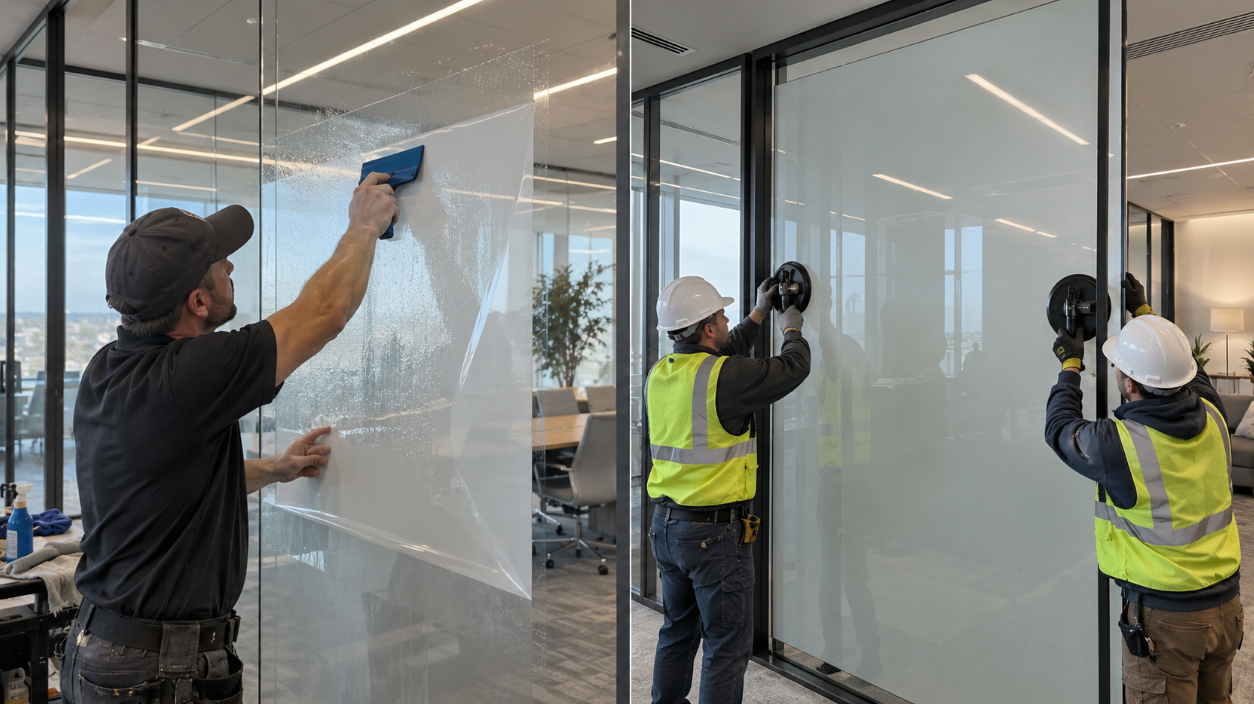
How does switchable glass work? On the same PDLC principle — the difference between smart film and smart glass isn't the technology; it's where the PDLC layer lives. Smart film adheres to the surface of glass you already have. Smart glass (also called switchable glass or laminated smart glass) has the PDLC layer permanently sealed between two panes at the factory.
That single difference drives everything else:
|
Smart film |
Smart glass |
|
|
PDLC layer |
Applied to existing glass surface |
Laminated between two glass panes |
|
Installation |
Adhesive application + wiring |
Full glass replacement, glazier + electrician |
|
Retrofit-friendly |
Yes — the defining advantage |
No — requires new glass |
|
Cost |
Lower, especially on existing glazing |
Higher (new laminated units) |
|
Durability |
Surface layer, more exposed |
Sealed and protected between panes |
|
Typical use |
Interior partitions, offices, existing windows |
New construction, exterior glazing |
Smart film is the retrofit answer: existing glass dividers and partitions in an office can become switchable in a day without demolition. Smart glass makes sense in new construction, where the glazing is being specified from scratch anyway, and for exterior applications — standard self-adhesive films are rated for interior use, while exterior installations call for the laminated version sealed inside insulated glass units.
One honest caveat: smart film changes what you see, not what you hear. Adding film to glass doesn't meaningfully reduce sound transmission through it. If a glass-walled room needs acoustic privacy along with visual privacy, the glazing itself has to be acoustically specified — visual and conference room soundproofing are two separate problems that happen to share a wall.
Installation, Lifespan, and Everyday Use
Installation has two parts: applying the film and wiring it. The application resembles putting a screen protector on a phone at architectural scale — the glass is cleaned, the liner is peeled, and the film is smoothed on. The wiring — busbar connections, transformer placement, switch or automation hookup — is electrical work. Small single-pane projects are manageable as DIY; large surfaces punish inexperience with bubbles, misalignment, and damaged edge connections, which is why bigger glass film installation projects are usually done professionally. A film with a creased ITO layer or a botched busbar connection can't be repaired, only replaced.
Properly installed, PDLC film is a long-service product. Quality film is rated for 100,000+ switching cycles and a practical service life of 10–15 years, with over 80,000 hours in the powered clear state. Since most users keep the film on only when rooms are occupied, real-world lifespan often stretches further. Along the way it also blocks 99% of UV radiation, which protects furniture and flooring from fading as a side benefit.
Maintenance is minimal: routine cleaning with non-abrasive solutions, no polishing compounds, no ammonia-heavy glass cleaners on film edges. If a project involves multiple rooms, unusual glass shapes, or integration with an automation system, a walkthrough with an installer before ordering saves the two classic mistakes — underestimating the transformer setup and cutting film on site, which damages the conductive layers and voids most warranties.