
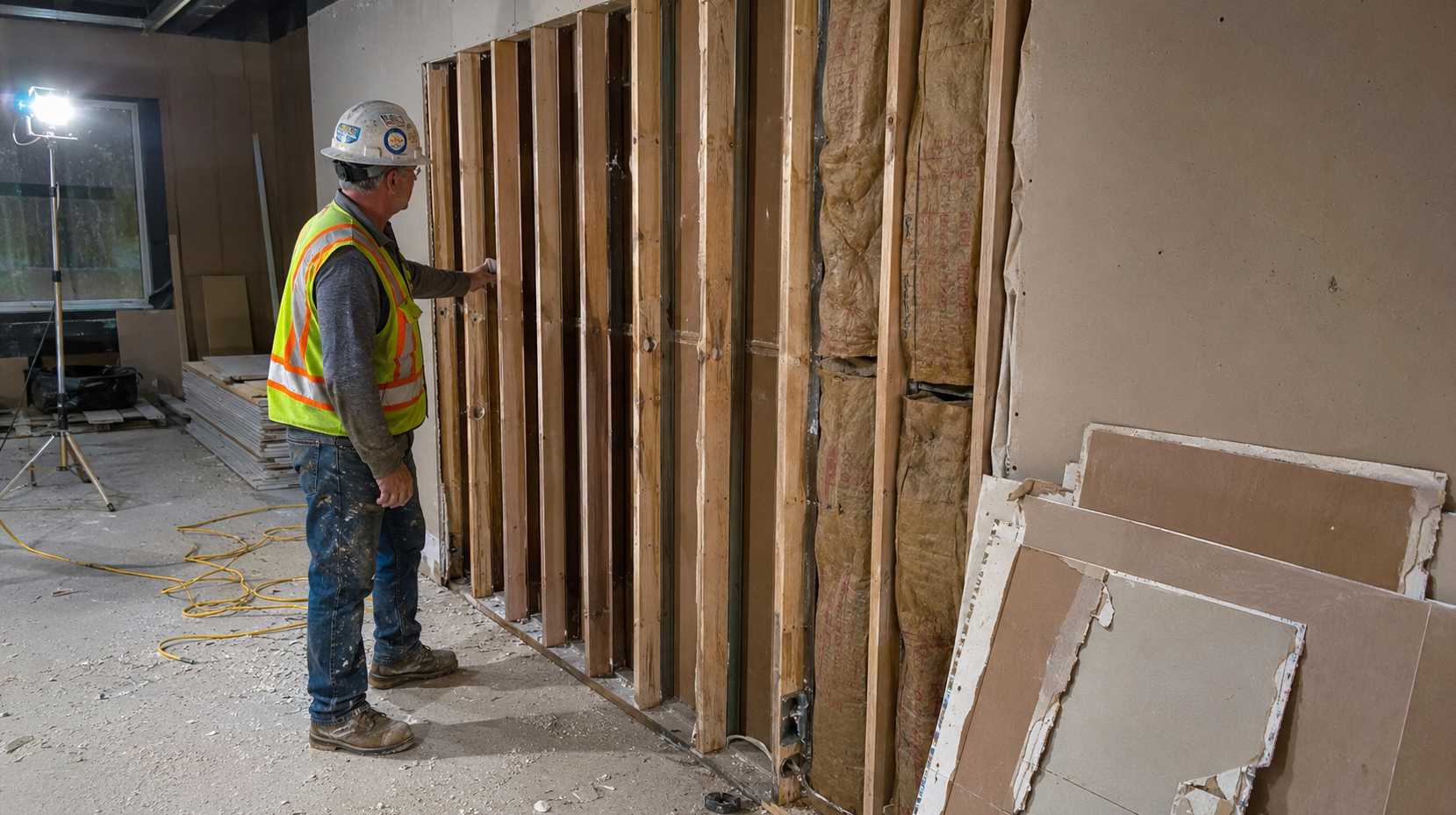
The triple leaf effect is a drop in sound isolation that occurs when a wall, ceiling, or floor contains three layers of mass separated by two air cavities instead of two layers separated by one. With the same total mass and thickness, the triple leaf version performs worse, because splitting one deep cavity into two shallow ones raises their resonance frequencies into the audible range. The fix in most cases: remove the middle layer and merge the two cavities into one.
What the Triple Leaf Effect Is
A leaf is any continuous layer of mass in an assembly: a sheet of drywall, a concrete wall, a pane of glass. A standard soundproofed partition is a double leaf, or mass-air-mass, system: two leaves with one air cavity between them, usually filled with insulation. A triple leaf adds a third layer of mass, which divides the space into two separate cavities.
The problem is counterintuitive because more layers feel like more protection. In practice, an assembly of identical mass and identical total depth isolates measurably better as a double leaf than as a triple leaf; lab comparisons show the triple leaf configuration giving up several STC points, and the loss concentrates in the low frequencies where isolation is hardest to buy.
The number of layers itself is not the villain. Two deep cavities perform acceptably; the damage comes from the shallow cavities that a middle leaf almost always creates within a fixed wall depth. This distinction drives every recommendation below.
Why Two Small Cavities Perform Worse Than One Large
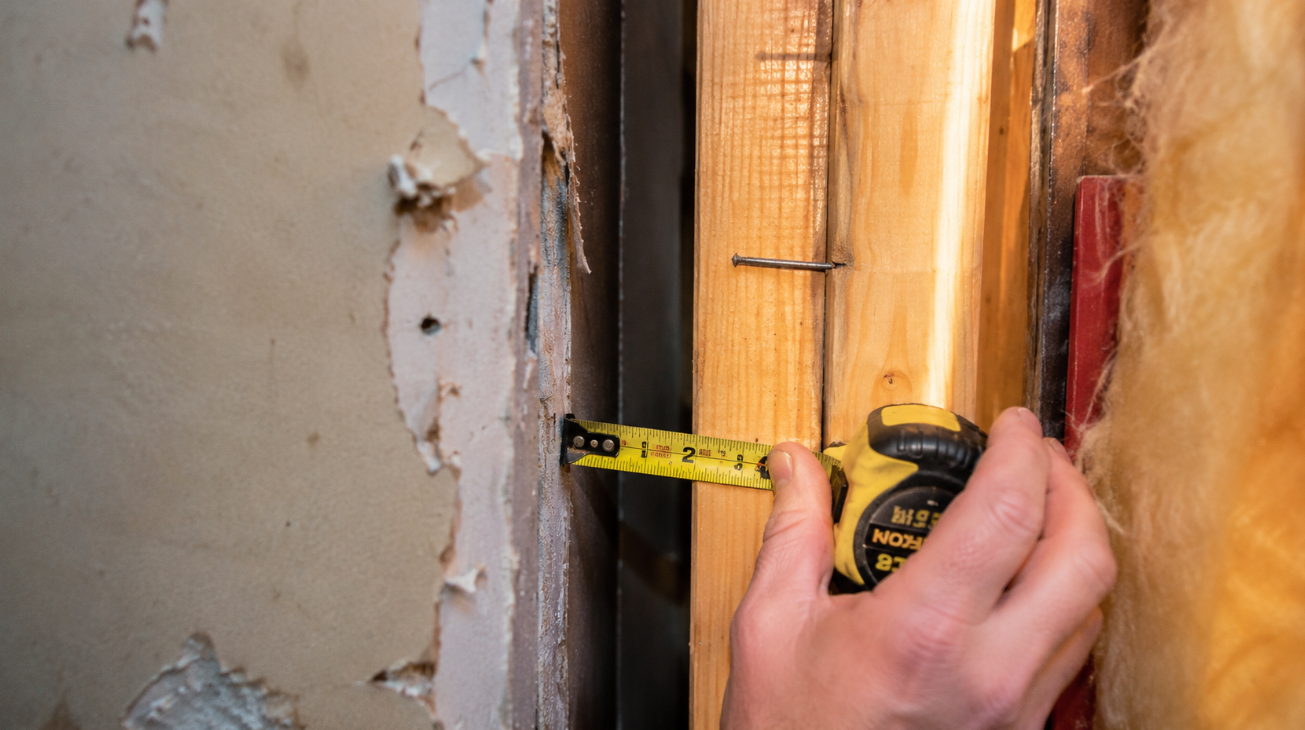
Each sealed air cavity behaves as a spring between two masses, and every mass-spring system has a resonance frequency. At that frequency, the cavity amplifies sound transfer through the assembly instead of blocking it, so isolation near resonance collapses regardless of how much the wall blocks elsewhere.
Cavity depth and leaf mass set the resonance point: a deeper cavity and heavier leaves push resonance lower, while a shallow cavity pushes it higher. A double stud wall with a deep insulated cavity resonates below roughly 50-60 Hz, under most program material. Split that same depth into two shallow cavities and each one resonates well up into the audible bass range, where footsteps, traffic, and music carry their energy.
Insulation in the cavity softens the spring, which acoustically mimics a somewhat deeper cavity and moves resonance lower. This helps every assembly, but it cannot rescue a shallow triple leaf cavity; the geometry sets the ceiling of what insulation can recover.
The practical consequence: adding a middle leaf costs money, labor, and several STC points at once. The same drywall moved to the outer leaves of a single-cavity design adds isolation instead of subtracting it.
How to Recognize a Triple Leaf in Your Construction
Triple leaves are almost never designed on purpose; they appear when a new layer goes over an existing finished surface. Four scenarios account for most cases:
|
Scenario |
Hidden middle leaf |
Two cavities formed |
|
New stud wall built in front of an existing finished wall |
The old drywall left on the cavity side |
Old stud bay + gap between old wall and new framing |
|
Resilient channel or isolation clips over an existing ceiling |
The old ceiling drywall left in place |
Joist bay + shallow channel gap |
|
Room-in-a-room with the outer frame sheathed on both sides |
Drywall on the inner face of the outer wall |
Outer wall cavity + gap between the two frames |
|
Prefab "soundproof panels" on furring over a finished wall |
The existing drywall under the furring |
Stud bay + furring gap behind the panel |
The recognition rule: count continuous mass layers from one side of the assembly to the other. Three or more layers with sealed air spaces between them means the effect applies. Wall assemblies attract this mistake most often, since layering over an existing surface is the path of least demolition; properly engineered wall soundproofing starts by deciding which existing layers must come down before anything new goes up.
How to Avoid or Fix a Triple Leaf
The base rule: remove the middle leaf and join the two cavities into one. The demolished drywall's mass belongs on the outer leaves, where a second or third layer with damping compound raises isolation instead of splitting the cavity.
Applied to the common scenarios:
- Before building a new wall in front of an old one, strip the old drywall on the cavity side. The new assembly becomes a clean double leaf with a deep insulated cavity.
- Before installing resilient channel or clips on a ceiling, take down the existing ceiling drywall. Clips mounted to bare joists with new drywall below produce one deep decoupled cavity; over old drywall they produce a shallow resonant one. This single demolition step separates working ceiling soundproofing from an expensive assembly that underperforms its parts.
- In a room-in-a-room, leave the outer frame unsheathed on the inner side. One leaf on the building shell, one on the inner room, one large cavity between them.
When demolition is impossible (structural finishes, lease restrictions), the palliative is to make the remaining geometry as favorable as it can get: maximize the new cavity's depth, fill both cavities with insulation, and add mass to the outermost leaf. This softens the penalty without removing it, and decoupling the new layer remains the strongest single lever in the assembly. Borderline cases justify a design check before construction; an acoustic consultation and design pass over the planned section catches a hidden middle leaf on paper, where fixing it costs nothing.
When a Triple Leaf Is Acceptable

A triple leaf with two deep cavities does not carry the penalty, because both resonance frequencies land below the range that matters. The rule of thumb: when each cavity approaches the depth of a full stud bay or more, the third leaf stops hurting and its extra mass starts helping.
Two configurations use this legitimately. Studio observation windows routinely run two or three panes of heavy laminated glass with wide, unequal air gaps; the gaps are large enough that resonances sit low, and unequal spacing staggers what remains. In recording studio soundproofing, this triple-glazed window design is standard practice between control room and live room.
The second case is an existing massive core, such as a concrete wall or slab, with decoupled drywall assemblies built on both sides. The concrete becomes the middle leaf, but each new cavity is framed deep, insulated, and decoupled, so the assembly performs as two independent mass-air-mass systems anchored to a heavy core.
The criterion, in both cases, is cavity depth. Judge any three-leaf design by its shallowest cavity: if that cavity is deep enough to push resonance below the content you need to block, the design stands.
The Bottom Line on Triple Leaf Assemblies
A triple leaf loses isolation because two shallow cavities resonate in the audible range where one deep cavity would not; the layer count is a symptom, cavity depth is the cause. With equal mass, the double leaf wins by several STC points, and the gap is widest in the bass.
Check every retrofit for a hidden middle leaf before building: old drywall behind a new wall, an old ceiling above new channel, sheathing on the wrong side of an outer frame. Demolishing one obsolete layer is the cheapest STC upgrade in the entire project.
Deep cavities forgive a third leaf, shallow ones punish it. Studio windows and drywalled concrete cores pass the test; a furring gap over finished drywall never does.